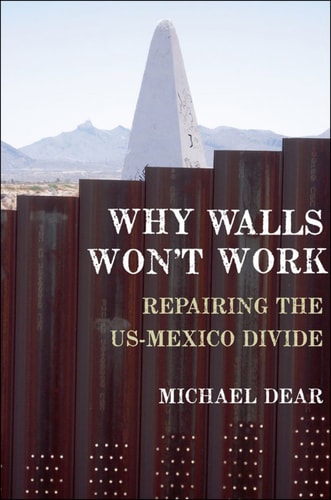
Why Walls Won't Work: Repairing the US-Mexico Divide
0
0
As an Amazon Associate and affiliate partner, Menrva Books earns from qualifying purchases. Learn more
Author Description
Why Walls Won't Work is a sweeping account of life along the United States-Mexico border zone, tracing the border's history of cultural interaction since the earliest Mesoamerican times to the present day. As soon as Mexicans, American settlers, and indigenous peoples came into contact along the Rio Grande in the mid-nineteenth century, new forms of interaction and affiliation evolved. By the late-twentieth century, the border states were among the fastest-growing regions in both countries. But as Michael Dear warns, this vibrant zone of economic, cultural and social connectivity is today threatened by highly restrictive American immigration and security policies as well as violence along the border. The U.S. border-industrial complex and the emerging Mexican narco-state are undermining the very existence of the "third nation" occupying the space between Mexico and the U.S. Through a series of evocative portraits of contemporary border communities, Dear reveals how the promise and potential of this "in-between" nation still endures and is worth protecting. Now with a new chapter updating this story and suggesting what should be done about the challenges confronting the cross-border zone, Why Walls Won't Work represents a major intellectual intervention into one of the most hotly-contested political issues of our era.
Menrva's Summary
THE THESIS
This book investigates the historical, cultural, and economic viability of the United States-Mexico border region, arguing that restrictive security policies and physical barriers are counterproductive to the natural integration of this unique 'third nation.' Michael Dear, a professor of city and regional planning, utilizes a combination of historical analysis and contemporary ethnographic portraits to challenge the efficacy of the border-industrial complex. He posits that the region functions as a distinct, interconnected space that is currently being destabilized by both American security mandates and the rise of the Mexican narco-state. The work serves as an intellectual framework for understanding the border not as a line of separation, but as a zone of long-standing social and economic exchange.
THE SCOPE MAP
What You Will Find
- Historical analysis of cultural interaction along the Rio Grande from Mesoamerican times to the present.
- Ethnographic portraits of contemporary border communities and their daily social dynamics.
- Critical examination of the U.S. border-industrial complex and its impact on regional connectivity.
- Policy recommendations for addressing the challenges of the cross-border zone.
THE AUTHORITY PERSPECTIVE
Experts and scholars in the field of border studies recognize this work as a significant contribution to the discourse on regional integration and security policy. Readers frequently note the author's ability to balance academic rigor with accessible, human-centered narratives regarding the realities of life in the borderlands.
Page Count:
286
Publication Date:
2013-01-01
Publisher:
Oxford University Press
ISBN-10:
0199323909
ISBN-13:
9780199323906
History
Sociology
Border Studies
DemographyPopulation
International relations
Community Tags
Other Editions(2)

Similar Books