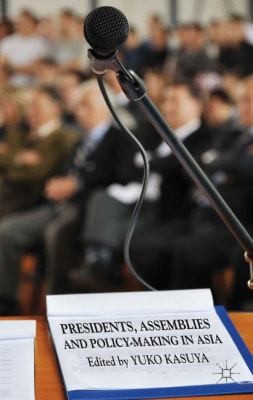
Presidents Assemblies and Policymaking in Asia
0
0
As an Amazon Associate and affiliate partner, Menrva Books earns from qualifying purchases. Learn more
Author Description
Which Asian presidents are 'stronger' in terms of their constitutional and partisan authorities? How do they use these authorities to advance their policy agendas? This book answers these questions and is one of the first and most comprehensive analyses of Asia's presidential and semi-presidential democracies. To develop a baseline, it measures the 'strength' of the Asian presidents with regards to their constitutional and partisan powers. Using this two-dimensional strength measure as a common framework, country study chapters on Afghanistan, Indonesia, the Philippines, South Korea, Sri Lanka, and Taiwan analyze how their constitutional and partisan powers are used in actual policy-making processes.
Menrva's Summary
THE THESIS
This book investigates the constitutional and partisan powers of presidents in Asia and how these powers are utilized in policymaking. It offers a comprehensive analysis of presidential and semi-presidential democracies across the continent, establishing a baseline measure for presidential 'strength' based on both constitutional and partisan authorities. Through comparative case studies of Afghanistan, Indonesia, the Philippines, South Korea, Sri Lanka, and Taiwan, the book examines the practical application of these powers within actual policy-making processes.
THE SCOPE MAP
- A comparative analysis of presidential and semi-presidential systems in Asia.
- A two-dimensional measure of presidential 'strength' based on constitutional and partisan powers.
- In-depth case studies of policy-making in Afghanistan, Indonesia, the Philippines, South Korea, Sri Lanka, and Taiwan.
- Examination of how presidents leverage their authorities to advance policy agendas.
THE AUTHORITY PERSPECTIVE
This book is recognized as a significant contribution to the study of Asian political systems, particularly focusing on the executive branch. Scholars likely find its comparative framework and detailed case studies valuable for understanding the nuances of presidential power in diverse Asian contexts. The analysis of how constitutional and partisan strengths translate into actual policy outcomes provides a robust foundation for further research in comparative politics and Asian governance.
Page Count:
209
Publication Date:
2013-01-01
ISBN-10:
1137277262
ISBN-13:
9781137277268
History
Science
Politics
Non-Fiction
Comparative Politics
Policy Making
Asian Studies
Community Tags
Similar Books