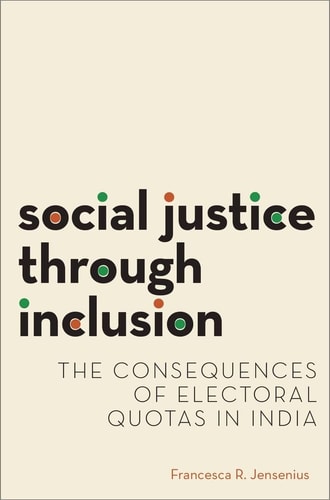
Social Justice through Inclusion: The Consequences of Electoral Quotas in India
0
0
As an Amazon Associate and affiliate partner, Menrva Books earns from qualifying purchases. Learn more
Author Description
Across the world, governments design and implement policies with the explicit goal of promoting social justice. But can such institutions change entrenched social norms? And what effects should we expect from differently designed policies? Francesca R. Jensenius' Social Justice through Inclusion is an empirically rich study of one of the most extensive electoral quota systems in the world: the reserved seats for the Scheduled Castes (SCs, the former "untouchables") in India's legislative assemblies. Combining evidence from quantitative datasets from the period 1969-2012, archival work, and in-depth interviews with politicians, civil servants, and voters across India, the book explores the long-term effects of electoral quotas for the political elite and the general population. It shows that the quota system has played an important role in reducing caste-based discrimination, particularly at the elite level. Interestingly, this is not because the system has led to more group representation - SC politicians working specifically for SC interests - but because it has made possible the creation and empowerment of a new SC elite who have gradually become integrated into mainstream politics. This is a study of India, but the findings and discussions have broader implications. Policies such as quotas are usually supported with arguments about various assumed positive long-term consequences. The nuanced discussions in this book shed light on how electoral quotas for SCs have shaped the incentives for politicians, parties, and voters, and indicate the trade-offs inherent in how such policies of group inclusion are designed.
Menrva's Summary
THE THESIS
This book investigates whether institutional mechanisms like electoral quotas can effectively alter entrenched social norms and what specific consequences arise from their implementation. Francesca R. Jensenius, a scholar specializing in South Asian politics, utilizes a rigorous empirical framework to analyze the long-term impact of reserved legislative seats for Scheduled Castes in India. By synthesizing quantitative data, archival records, and qualitative interviews, the author argues that these quotas have fostered the integration of a new political elite rather than merely increasing group-specific representation.
THE SCOPE MAP
What You Will Find
- Quantitative analysis of Indian legislative data spanning 1969 to 2012
- Examination of political incentives for parties, candidates, and voters
- Qualitative insights from interviews with civil servants and politicians
- Theoretical discussion on the design of group-inclusion policies
Scope Limits
- The study focuses specifically on the Indian context of Scheduled Caste reservations
- It does not provide a universal blueprint for quota implementation in non-democratic systems
THE AUTHORITY PERSPECTIVE
Experts recognize this work as a significant contribution to the study of institutional design and caste politics in India. Readers frequently note the academic density of the prose and the author's meticulous approach to reconciling quantitative datasets with complex social realities.
Page Count:
248
Publication Date:
2017-07-31
Publisher:
Oxford University Press
ISBN-10:
0190646608
ISBN-13:
9780190646608
Social justice
Public Policy
Sociology
Representative government and representation
Ethnic Studies
Asian Studies
Caste
Comparative Politics
Electoral Systems
Dalits
Community Tags
Similar Books