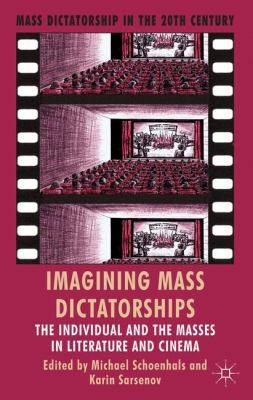
Imagining Mass Dictatorships: The Individual And The Masses In Literature And Cinema
0
0
As an Amazon Associate and affiliate partner, Menrva Books earns from qualifying purchases. Learn more
Author Description
This volume in the series 'Mass Dictatorship in the Twentieth Century' sees twelve Swedish, Korean and Japanese scholars, theorists, and historians of fiction and non-fiction probe the literary subject of life in 20th century mass dictatorships. Generously defined, the 'literary' in this context covers a wide spectrum of narrative forms, ranging from the commercial television documentary to popular crime fiction, and from digitally restored amateur film on DVD to the Nobel Prize winning novel. It deals with mass dictatorship regimes as far apart as Nazi Germany, Park Chung-hee's South Korea, Stalinist Russia, post-war Hungary, Mao Zedong's China, apartheid's South Africa, and Ceausescu's Romania. The interplay of analytical ideas and the transnational perspectives that this volume brings add a new dimension to our understanding of traumatic events - 'dark chapters' - in 20th century history. By focusing the immense role of imagination within a cultural discourse otherwise dominated by irrefutable facts such as the existence of Holocaust and Gulag, this volume opens new ways of thinking perceptively about trauma, power and self
Menrva's Summary
THE THESIS
This volume investigates the literary and cinematic representations of individual experience within 20th-century mass dictatorships. It brings together twelve scholars from Sweden, Korea, and Japan to analyze a wide spectrum of narrative forms, including documentaries, crime fiction, amateur films, and novels, across diverse regimes such as Nazi Germany, Stalinist Russia, Maoist China, and apartheid South Africa. The book explores how imagination shapes cultural discourse around traumatic historical events, offering new perspectives on power, trauma, and the self.
THE SCOPE MAP
- Analysis of literary and cinematic works depicting life under mass dictatorships.
- Exploration of diverse narrative forms: documentary, crime fiction, amateur film, novels.
- Case studies from various 20th-century regimes including Nazi Germany, Stalinist Russia, Maoist China, and apartheid South Africa.
- Focus on the interplay of imagination and cultural discourse in understanding traumatic historical events.
- Transnational perspectives from Swedish, Korean, and Japanese scholars.
- Examination of themes of trauma, power, and the individual's relationship to the masses.
THE AUTHORITY PERSPECTIVE
This volume is part of the series 'Mass Dictatorship in the Twentieth Century,' suggesting a scholarly and academic focus. The collection of essays by international scholars from diverse backgrounds indicates a commitment to comparative and transnational analysis of historical and cultural phenomena. The book's approach, which emphasizes the role of imagination in understanding traumatic events, points to a nuanced exploration of history that goes beyond factual accounts to consider subjective experience and cultural representation.
Page Count:
327
Publication Date:
2013-01-01
ISBN-10:
1137330686
ISBN-13:
9781137330680
Non-Fiction
Fiction
History
Science
Literary Criticism
Community Tags
Similar Books