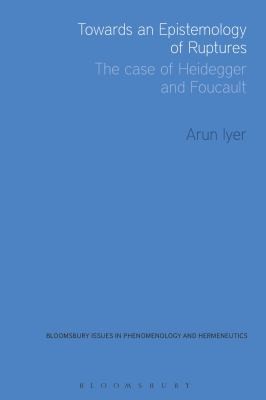
Towards an Epistemology of Ruptures
0
0
As an Amazon Associate and affiliate partner, Menrva Books earns from qualifying purchases. Learn more
Author Description
By systematically uncovering and comprehensively examining the epistemological implications of Heidegger's history of being and Foucault's archaeology of discursive formations, Towards an Epistemology of Ruptures shows how Heidegger and Foucault significantly expand the notions of knowledge and thought. This is done by tracing their path-breaking responses to the question: What is the object of thought? The book shows how for both thinkers thought is not just the act by which the object is represented in an idea, and knowledge not just a state of the mind of the individual subject corresponding to the object. Each thinker, in his own way, argues that thought is a productive event in which the subject and the object gain their respective identity and knowledge is the opening up of a space in which the subject and object can encounter each other and in which true and false statements about an object become possible. They thereby lay the ground for a new conceptual framework for rethinking the very relationship between knowledge and its object.--Bloomsbury Publishing.
Menrva's Summary
THE THESIS
This book investigates how the philosophical concepts of Martin Heidegger and Michel Foucault redefine our understanding of knowledge and thought. By analyzing Heidegger's history of being and Foucault's archaeology of discursive formations, Arun Iyer demonstrates how both thinkers challenge traditional notions of knowledge as mere mental representation or subjective states. Instead, they propose that thought is a dynamic event that shapes both subject and object, and knowledge is the very space where this encounter occurs and where truth claims become possible. The book thus offers a new framework for understanding the fundamental relationship between knowledge and its object.
THE SCOPE MAP
- Systematic examination of the epistemological implications of Heidegger's history of being.
- Comprehensive analysis of Foucault's archaeology of discursive formations.
- Exploration of how Heidegger and Foucault expand the concepts of knowledge and thought.
- Tracing their responses to the question: What is the object of thought?
- Argument that thought is a productive event shaping subject and object identity.
- Explanation of knowledge as an opening of space for subject-object encounter.
- Discussion of how true and false statements about an object become possible within this framework.
- Proposal of a new conceptual framework for rethinking the relationship between knowledge and its object.
THE AUTHORITY PERSPECTIVE
The book is presented as a significant contribution to understanding the works of Heidegger and Foucault, particularly concerning their theories of knowledge and thought. It aims to provide a novel conceptual framework that challenges traditional philosophical approaches. The analysis focuses on the productive and relational aspects of thought and knowledge, moving beyond subjective representation. The work is positioned to offer a deeper engagement with these foundational thinkers for scholars in phenomenology, hermeneutics, and epistemology.
Page Count:
232
Publication Date:
2014-01-01
ISBN-10:
144113767X
ISBN-13:
9781441137678
Art
Non-Fiction
Philosophy
Continental Philosophy
Discourse Analysis
Epistemology
Community Tags
Similar Books