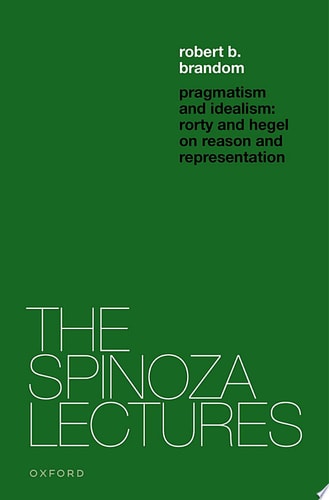
Pragmatism and Idealism: Rorty and Hegel on Representation and Reality
0
0
As an Amazon Associate and affiliate partner, Menrva Books earns from qualifying purchases. Learn more
Author Description
In this short book, based upon his Spinoza Lectures at the University of Amsterdam, Robert B. Brandom offers a pragmatist approach to representation and reality, drawing on Richard Rorty and Hegel.During the last decade of his life, Rorty emphasized the anti-authoritarian credentials of his pragmatism. He came to see pragmatism as the fighting faith of a second phase of the Enlightenment. The first stage, as Rorty construed it, concerned our emancipation from nonhuman authority in practical matters: issues of what we ought to do and how things ought to be. The envisaged second stage addresses rather our emancipation from nonhuman authority in theoretical matters.Brandom shows how pragmatism moves beyond the traditional model of reality as authoritative over our cognitive representations of it in language and thought, to a new conception of how discursive practices help us cope with the vicissitudes of life. Hegel anticipates the challenge to the very idea of objective reality as providing norms for thought which Rorty believed required us to enact a second phase of the Enlightenment. Unlike Rorty, Hegel presents a detailed, constructive, anti-authoritarian, non-fetishistic, social pragmatist account of the representational dimension of conceptual content. At its heart is an account of the social dimension of discursive normativity in terms of reciprocal recognition, and an account of the historical dimension of discursive normativity in terms of a distinctive new conception of reason: the recollective rationality that turns a past into a tradition. His idealism thereby offers a concrete pragmatist alternative to Rorty's global semantic and epistemological anti-representationalism.
Menrva's Summary
THE THESIS
This work investigates how the philosophical frameworks of Richard Rorty and G.W.F. Hegel address the relationship between discursive representation and objective reality. Robert B. Brandom, a prominent philosopher of language and mind, utilizes his Spinoza Lectures to contrast Rorty’s anti-representationalist pragmatism with Hegel’s social and historical account of conceptual content. Brandom argues that while both thinkers seek to move beyond traditional models of nonhuman authority, Hegel provides a more robust, constructive alternative through his concepts of reciprocal recognition and recollective rationality.
THE SCOPE MAP
What You Will Find
- A comparative analysis of Rorty’s second-phase Enlightenment pragmatism and Hegelian idealism.
- An examination of discursive normativity and its social and historical dimensions.
- A critique of the traditional model of reality as an authoritative constraint on cognitive representation.
Scope Limits
- The text does not provide a comprehensive survey of all pragmatist thought or the entirety of Hegel’s corpus.
- It focuses specifically on the intersection of representation and reality rather than broader political or ethical applications of these philosophers' work.
THE AUTHORITY PERSPECTIVE
Scholars and students of contemporary philosophy frequently note the technical density of Brandom’s prose, which requires a strong background in analytic and continental traditions. Experts highlight this text as a significant contribution to the ongoing dialogue between pragmatist and idealist interpretations of conceptual content.
Page Count:
160
Publication Date:
2023-02-17
Publisher:
Oxford University Press
ISBN-10:
0192870211
ISBN-13:
9780192870216
Philosophy
Metaphysics
Epistemology
Idealism
Pragmatism
Continental Philosophy
Community Tags
Similar Books