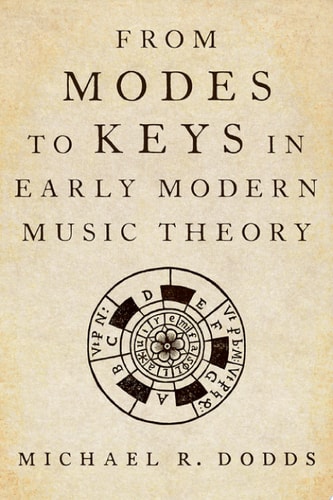
From Modes to Keys in Early Modern Music Theory
0
0
As an Amazon Associate and affiliate partner, Menrva Books earns from qualifying purchases. Learn more
Author Description
From Modes to Keys in Early Modern Music Theory addresses one of the broadest and most elusive open topics in music history: the transition from the Renaissance modes to the major and minor keys of the high Baroque. The system Glarean proposed in his 1547 Dodecachordon comprised twelve modes at two transposition levels; the scheme J.S. Bach used to order The Well-Tempered Clavier in 1722 featured two modes at twelve transposition levels. What took place in between?Through deep engagement with the corpus of Western music theory, author Michael R. Dodds presents a model to clarify the factors of this complex shift. The essence of this model lies in the dynamic interplay of three historical-conceptual layers arising successively in the Middle Ages, Renaissance, and Baroque, each layer continuing once introduced. Medieval theorists conceptualized mode along a continuum between tune and scale. Renaissance theorists extended mode from plainchant to polyphony, applying modal theory to such features as cadential hierarchies and contrapuntal imitation. Early Baroque mapping of vocal modality onto the keyboard catalyzed a transformation from the diatonic gamut to the chromatic keyboard as background pitch system, with a corresponding change from ladder to circle as the dominant model for tonal space, culminating in the circle of fifths. Spanning two centuries of music and music theory, and incorporating dozens of diagrams from historical treatises, Dodds provides the first comprehensive study of the transition from the Renaissance modes to the major and minor keys.
Menrva's Summary
THE THESIS
This book investigates the historical and conceptual transition from the Renaissance modal system to the major and minor key system of the high Baroque. Author Michael R. Dodds, a scholar of music history, utilizes a deep analysis of Western music theory treatises to construct a model explaining this shift. He argues that the transformation occurred through the layering of three distinct conceptual frameworks developed across the Middle Ages, Renaissance, and Baroque periods. By examining the evolution of pitch systems and tonal space, Dodds clarifies how the diatonic gamut eventually gave way to the chromatic keyboard and the circle of fifths.
THE SCOPE MAP
What You Will Find
- A historical analysis of music theory spanning from the 16th-century Dodecachordon to the 18th-century Well-Tempered Clavier.
- A conceptual model detailing the interplay between medieval, Renaissance, and Baroque modal theories.
- Extensive use of diagrams and excerpts from primary source historical treatises.
- An examination of the shift from vocal modality to keyboard-based tonal systems.
THE AUTHORITY PERSPECTIVE
Experts recognize this work as a comprehensive study that fills a significant gap in musicological literature regarding tonal evolution. Readers frequently note the academic density of the prose and the value of the included historical diagrams for understanding complex theoretical shifts.
Page Count:
512
Publication Date:
2023-01-01
Publisher:
Oxford University Press
ISBN-10:
0199338159
ISBN-13:
9780199338153
Music theory
Music History
Musicology
Renaissance
Baroque
Community Tags
Other Editions(2)

Similar Books