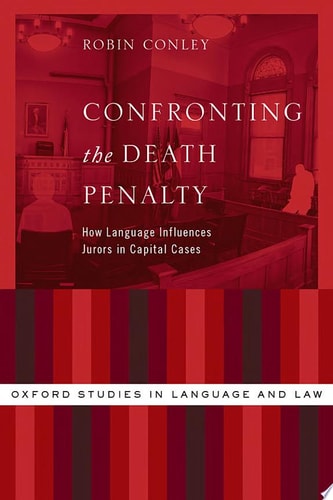
Confronting the Death Penalty: How Language Influences Jurors in Capital Cases
0
0
As an Amazon Associate and affiliate partner, Menrva Books earns from qualifying purchases. Learn more
Author Description
Confronting the Death Penalty: How Language Influences Jurors in Capital Cases probes how jurors make the ultimate decision about whether another human being should live or die. Drawing on ethnographic and qualitative linguistic methods, this book explores the means through which language helps to make death penalty decisions possible - how specific linguistic choices mediate and restrict jurors', attorneys', and judges' actions and experiences while serving and reflecting on capital trials.The analysis draws on fifteen months of ethnographic fieldwork in diverse counties across Texas, including participant observation in four capital trials and post-verdict interviews with the jurors who decided those cases. Given the impossibility of access to actual capital jury deliberations, this integration of methods aims to provide the clearest possible window into jurors' decision-making. Using methods from linguistic anthropology, conversation analysis, and multi-modal discourse analysis, Conley analyzes interviews, trial talk, and written legal language to reveal a variety of communicative practices through which jurors dehumanize defendants and thus judge them to be deserving of death.By focusing on how language can both facilitate and stymie empathic encounters, the book addresses a conflict inherent to death penalty trials: jurors literally face defendants during trial and then must distort, diminish, or negate these face-to-face interactions in order to sentence those same defendants to death. The book reveals that jurors cite legal ideologies of rational, dispassionate decision-making - conveyed in the form of authoritative legal language - when negotiating these moral conflicts. By investigating the interface between experiential and linguistic aspects of legal decision-making, the book breaks new ground in studies of law and language, language and psychology, and the death penalty.
Menrva's Summary
THE THESIS
This book investigates how specific linguistic practices and legal ideologies influence the moral decision-making processes of jurors in capital punishment cases. Author Robin Conley, a scholar in linguistic anthropology, utilizes fifteen months of ethnographic fieldwork and qualitative analysis to examine the intersection of language, law, and human psychology. By analyzing trial transcripts, legal instructions, and post-verdict interviews, the work argues that jurors employ specific communicative strategies to navigate the inherent conflict between face-to-face human interaction and the mandate to impose a death sentence.
THE SCOPE MAP
What You Will Find
- Ethnographic data from fifteen months of fieldwork conducted across diverse Texas counties.
- Analysis of four capital trials through participant observation and post-verdict juror interviews.
- Methodologies derived from linguistic anthropology, conversation analysis, and multi-modal discourse analysis.
- Examination of how legal language facilitates the dehumanization of defendants to justify capital sentencing.
THE AUTHORITY PERSPECTIVE
Experts in the fields of law and linguistics identify this work as a significant contribution to the study of legal discourse and capital punishment. Readers frequently note the academic rigor of the methodology and the clarity with which the author connects abstract linguistic theory to the high-stakes environment of the courtroom.
Page Count:
256
Publication Date:
2015-12-01
Publisher:
Oxford University Press
ISBN-10:
0199334161
ISBN-13:
9780199334162
Psychology
Jury
Law
Criminology
Decision Making
Linguistics
Sociology
Community Tags
Other Editions(2)
Similar Books


Reader Comments
Share Your Thoughts
No comments yet. Be the first to share your thoughts!