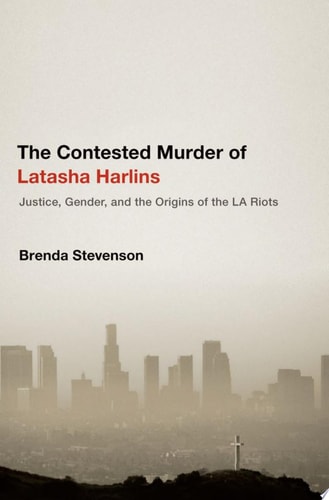
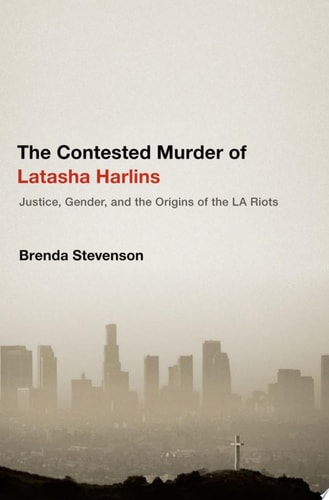
The Contested Murder of Latasha Harlins: Justice, Gender, and the Origins of the LA Riots
0
0
As an Amazon Associate and affiliate partner, Menrva Books earns from qualifying purchases. Learn more
Author Description
Helicopters patrolled low over the city, filming blocks of burning cars and buildings, mobs breaking into storefronts, and the vicious beating of truck driver Reginald Denny. For a week in April 1992, Los Angeles transformed into a cityscape of rage, purportedly due to the exoneration of four policemen who had beaten Rodney King. It should be no surprise that such intense anger erupted from something deeper than a single incident. In The Contested Murder of Latasha Harlins, Brenda Stevenson tells the dramatic story of an earlier trial, a turning point on the road to the 1992 riot. On March 16, 1991, fifteen-year-old Latasha Harlins, an African American who lived locally, entered the Empire Liquor Market at 9172 South Figueroa Street in South Central Los Angeles. Behind the counter was a Korean woman named Soon Ja Du. Latasha walked to the refrigerator cases in the back, took a bottle of orange juice, put it in her backpack, and approached the cash register with two dollar bills in her hand-the price of the juice. Moments later she was face-down on the floor with a bullet hole in the back of her head, shot dead by Du. Joyce Karlin, a Jewish Superior Court judge appointed by Republican Governor Pete Wilson, presided over the resulting manslaughter trial. A jury convicted Du, but Karlin sentenced her only to probation, community service, and a $500 fine. The author meticulously reconstructs these events and their aftermath, showing how they set the stage for the explosion in 1992. An accomplished historian at UCLA, Stevenson explores the lives of each of these three women-Harlins, Du, and Karlin-and their very different worlds in rich detail. Through the three women, she not only reveals the human reality and social repercussions of this triangular collision, she also provides a deep history of immigration, ethnicity, and gender in modern America. Massively researched, deftly written, The Contested Murder of Latasha Harlins will reshape our understanding of race, ethnicity, and the law in America.
Menrva's Summary
THE THESIS
How did the 1991 killing of Latasha Harlins and the subsequent lenient sentencing of Soon Ja Du serve as a critical catalyst for the 1992 Los Angeles riots? Brenda E. Stevenson, a historian at UCLA, utilizes extensive archival research and legal records to examine the intersection of race, gender, and class in early 1990s Los Angeles. By analyzing the lives of the victim, the perpetrator, and the presiding judge, Stevenson argues that the Harlins case was not an isolated incident but a manifestation of deep-seated systemic tensions between the African American and Korean American communities. The text provides a rigorous historical framework to explain how these localized conflicts escalated into the broader civil unrest of 1992.
THE SCOPE MAP
What You Will Find
- A detailed reconstruction of the March 1991 shooting at the Empire Liquor Market.
- An analysis of the legal proceedings and the controversial sentencing by Judge Joyce Karlin.
- Biographical profiles of Latasha Harlins, Soon Ja Du, and Judge Joyce Karlin.
- A broader historical examination of immigration, ethnic relations, and gender dynamics in modern urban America.
THE AUTHORITY PERSPECTIVE
Scholars and historians recognize this work as a significant contribution to the study of urban unrest and the racial politics of Los Angeles. Readers frequently note the meticulous research and the author's ability to balance individual narratives with larger sociological trends.
Page Count:
443
Publication Date:
2013-01-01
Publisher:
Oxford University Press
ISBN-10:
0199339597
ISBN-13:
9780199339594
True Crime
History
Sociology
Legal Studies
Professional Career & Trade
Trials Murder
Race Relations
American History
Community Tags
Other Editions(2)
Similar Books





Reader Comments
Share Your Thoughts
No comments yet. Be the first to share your thoughts!