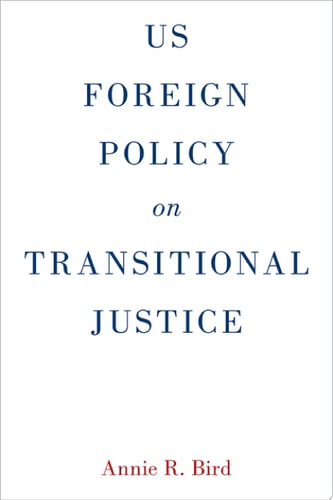
US Foreign Policy on Transitional Justice
0
0
As an Amazon Associate and affiliate partner, Menrva Books earns from qualifying purchases. Learn more
Author Description
Since the end of the Cold War, the United States has been a key driver of transitional justice. It has provided crucial political backing, as well as technical and financial assistance for trials, truth commissions, and other measures aimed at helping societies address serious human rights violations. Surprisingly, however, scholars have not analyzed closely the role of the US in transitional justice.This book offers the first systematic and cross-cutting account of US foreign policy on transitional justice. It explores the development of US foreign policy on the field from World War I to the present, and provides an in-depth examination of US involvement in measures in Cambodia, Liberia, and Colombia. Annie Bird supports her findings with nearly 200 interviews with key US and foreign government officials, staff of transitional justice measures, and country experts.By "opening the black box" of US foreign policy, the book shows how the diverse and evolving interests of presidential administrations, Congress, the State Department, and other agencies play a major role in shaping US involvement in transitional justice. The book argues that, despite multiple influences, US foreign policy on transitional justice is characterized by a distinctive approach that is symbolic, retributive, and strategic. As the book concludes, this approach has influenced the field as a whole, including the establishment, design, and implementation of transitional justice measures.
Menrva's Summary
THE THESIS
This book investigates the core question of how and why the United States has shaped the global landscape of transitional justice from the post-World War I era to the present day. Annie R. Bird, an expert in international policy, utilizes a vast dataset derived from nearly 200 interviews with government officials, policy staff, and regional experts to deconstruct the internal mechanisms of American foreign policy. The work argues that US involvement is not monolithic but is instead defined by a specific, recurring approach that balances symbolic gestures, retributive justice, and strategic national interests.
THE SCOPE MAP
What You Will Find
- A comprehensive historical analysis of US foreign policy regarding transitional justice from World War I through the modern era.
- Detailed case study examinations of US involvement in Cambodia, Liberia, and Colombia.
- A methodological framework that analyzes the competing interests of the State Department, Congress, and various presidential administrations.
- Evidence-based conclusions regarding the impact of US policy on the design and implementation of international justice measures.
THE AUTHORITY PERSPECTIVE
Experts recognize this work as a foundational text for understanding the intersection of American diplomacy and international human rights law. Scholars frequently highlight the book's systematic approach to opening the black box of bureaucratic decision-making as a significant contribution to the field.
Page Count:
238
Publication Date:
2015-03-04
Publisher:
Oxford University Press
ISBN-10:
0199338418
ISBN-13:
9780199338412
History
Professional Career & Trade
United States
Human rights
International relations
Foreign Policy
Community Tags
Other Editions(4)

Similar Books


Reader Comments
Share Your Thoughts
No comments yet. Be the first to share your thoughts!