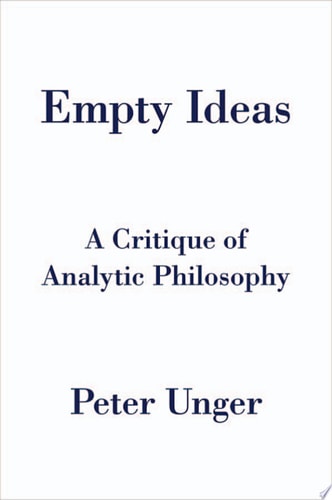
Empty Ideas
0
0
As an Amazon Associate and affiliate partner, Menrva Books earns from qualifying purchases. Learn more
Author Description
Peter Unger's Provocative New Book Poses A Serious Challenge To Contemporary Analytic Philosophy, Arguing That To Its Detriment It Focuses The Predominance Of Its Energy On Empty Ideas. In The Mid-twentieth Century, Philosophers Generally Agreed That, By Contrast With Science, Philosophy Should Offer No Substantial Thoughts About The General Nature Of Concrete Reality. Leading Philosophers Were Concerned With Little More Than The Semantics Of Ordinary Words. For Example: Our Word Perceives Differs From Our Word Believes In That The First Word Is Used More Strictly Than The Second. While Someone May Be Correct In Saying I Believe There's A Table Before Me Whether Or Not There Is A Table Before Her, She Will Be Correct In Saying I Perceive There's A Table Before Me Only If There Is A Table There. Though Just A Parochial Idea, Whether Or Not It Is Correct Does Make A Difference To How Things Are With Concrete Reality. In Unger's Terms, It Is A Concretely Substantial Idea. Alongside Each Such Parochial Substantial Idea, There Is An Analytic Or Conceptual Thought, As With The Thought That Someone May Believe There Is A Table Before Her Whether Or Not There Is One, But She Will Perceive There Is A Table Before Her Only If There Is A Table There. Empty Of Import As To How Things Are With Concrete Reality, Those Thoughts Are What Unger Calls Concretely Empty Ideas. It Is Widely Assumed That, Since About 1970, Things Had Changed Thanks To The Advent Of Such Thoughts As The Content Externalism Championed By Hilary Putnam And Donald Davidson, Various Essentialist Thoughts Offered By Saul Kripke, And So On. Against That Assumption, Unger Argues That, With Hardly Any Exceptions Aside From David Lewis's Theory Of A Plurality Of Concrete Worlds, All Of These Recent Offerings Are Concretely Empty Ideas. Except When Offering Parochial Ideas, Peter Unger Maintains That Mainstream Philosophy Still Offers Hardly Anything Beyond Concretely Empty Ideas.
Menrva's Summary
THE THESIS
Does contemporary analytic philosophy focus its intellectual energy on ideas that lack any substantial connection to the nature of concrete reality? Peter Unger, a prominent philosopher, critiques the prevailing trend in analytic philosophy since the mid-twentieth century, which he argues has retreated from substantive inquiry into the nature of the world. He posits that most modern philosophical discourse is preoccupied with conceptual or analytic thoughts that are devoid of concrete import, contrasting these with what he defines as concretely substantial ideas.
THE SCOPE MAP
What You Will Find
- A critical examination of the shift in analytic philosophy from substantive inquiry to semantic analysis.
- The distinction between concretely substantial ideas and concretely empty ideas.
- An evaluation of influential theories from figures such as Hilary Putnam, Donald Davidson, and Saul Kripke.
- A rare exception noted in the work of David Lewis regarding the theory of a plurality of concrete worlds.
THE AUTHORITY PERSPECTIVE
Experts and scholars in the field recognize this work as a provocative challenge to the methodology of mainstream analytic philosophy. Readers frequently note the high level of technical rigor required to follow Unger's arguments regarding the nature of conceptual versus concrete thought.
Page Count:
288
Publication Date:
2014-01-01
Publisher:
Oxford University Press
ISBN-10:
0199330824
ISBN-13:
9780199330829
Philosophy
Epistemology
Metaphysics
Community Tags
Other Editions(2)
Similar Books

Reader Comments
Share Your Thoughts
No comments yet. Be the first to share your thoughts!