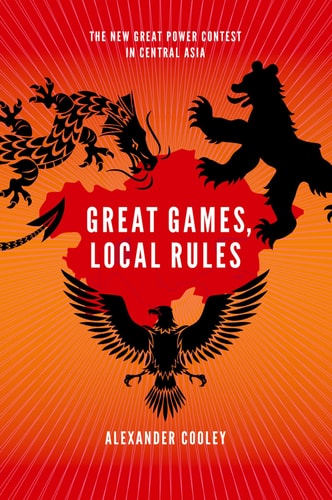
Great Games, Local Rules: The New Great Power Contest in Central Asia
0
0
As an Amazon Associate and affiliate partner, Menrva Books earns from qualifying purchases. Learn more
Author Description
The struggle between Russia and Great Britain over Central Asia in the nineteenth century was the original "great game." But in the past quarter century, a new "great game" has emerged, pitting America against a newly aggressive Russia and a resource-hungry China, all struggling for influence over the same region, now one of the most volatile areas in the world: the long border region stretching from Iran through Pakistan to Kashmir.In Great Games, Local Rules, Alexander Cooley, one of America's most respected international relations scholars, explores the dynamics of the new competition for control of the region since 9/11. All three great powers have crafted strategies to increase their power in the area, which includes Afghanistan and the former Soviet republics of Turkmenistan, Uzbekistan, Kyrgyzstan, and Kazakhstan. Each nation is pursuing important goals: basing rights for the US, access to natural resources for the Chinese, and increased political influence for the Russians.However, overlooked in all of the talk about this new great game is fact that the Central Asian governments have proven themselves critical agents in their own right, establishing local rules for external power involvement that serve to fend off foreign interest. As a result, despite a decade of intense interest from the United States, Russia, and China, Central Asia remains a collection of segmented states, and the external competition has merely reinforced the sovereign authority of the individual Central Asian governments. A careful and surprising analysis of how small states interact with great powers in a vital region, Great Games, Local Rules greatly advances our understanding of how global politics actually works in the contemporary era.
Menrva's Summary
THE THESIS
How do the sovereign states of Central Asia navigate and manipulate the competing strategic interests of global powers like the United States, Russia, and China? Alexander Cooley, a prominent scholar in international relations, utilizes a decade of post-9/11 political data to argue that the regional governments are not merely passive pawns. Instead, he presents a framework demonstrating how these smaller nations actively establish local rules to manage foreign influence and reinforce their own domestic authority.
THE SCOPE MAP
What You Will Find
- Analysis of the geopolitical competition between the US, Russia, and China in the post-9/11 era.
- Examination of the specific political strategies employed by Turkmenistan, Uzbekistan, Kyrgyzstan, and Kazakhstan.
- Case studies detailing the negotiation of basing rights, resource extraction, and political alignment.
- A theoretical framework for understanding how small states exert agency against larger global powers.
THE AUTHORITY PERSPECTIVE
Experts in the field of Eurasian studies frequently cite this work as a foundational text for understanding the nuances of Central Asian sovereignty. Readers often note the clarity of the prose, which effectively balances complex geopolitical theory with accessible historical context.
Page Count:
272
Publication Date:
2014-01-14
Publisher:
Oxford University Press
ISBN-10:
019933143X
ISBN-13:
9780199331437
History
Central Asia
Geopolitics
United States
International relations
Community Tags
Other Editions(2)
Similar Books