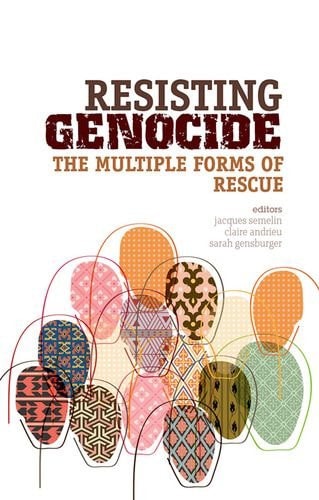
Resisting Genocide: The Multiple Forms of Rescue
0
0
As an Amazon Associate and affiliate partner, Menrva Books earns from qualifying purchases. Learn more
Author Description
Every genocide in history has been notable for the minority of brave individuals and groups who put their own lives at risk to rescue its would be victims. Based on three case studies--the genocides of the Armenians, the Jews and the Rwandese Tutsi--this book is the first international comparative and multidisciplinary attempt to make rescue an object of research, while breaking free of the notion of "The Righteous Among the Nations." The result is an exceptionally rich and disturbing volume. While it is impossible to distill or describe what makes an individual into a rescuer, acts of rescue reveal a historical fact: the existence of an informal, underground network of rescuers-- however fragile--as soon as genocides get underway, and in every geographical and social context.
Menrva's Summary
THE THESIS
This work investigates the sociological and political conditions that enable individuals to resist genocidal violence through the act of rescue. The authors, Claire Andrieu, Jacques Semelin, and Sarah Gensburger, utilize a multidisciplinary framework to analyze rescue behavior beyond the traditional hagiographic focus on individual heroism. By synthesizing historical data and comparative political analysis, they argue that rescue is not merely an anomaly of individual conscience but a recurring, albeit fragile, phenomenon that emerges within underground networks across diverse geographical and social contexts.
THE SCOPE MAP
What You Will Find
- Comparative analysis of three distinct genocides: the Armenian, the Jewish, and the Rwandan Tutsi.
- A multidisciplinary methodology combining history, political science, and sociology to categorize rescue behaviors.
- Examination of informal, underground networks that facilitate the protection of victims during mass violence.
- A critical reassessment of the concept of the Righteous Among the Nations to include broader social dynamics.
THE AUTHORITY PERSPECTIVE
Experts identify this text as a significant contribution to genocide studies for its shift away from individual moralizing toward structural analysis. Scholars frequently note the academic density of the prose and the rigor with which the authors apply comparative frameworks to sensitive historical events.
Page Count:
456
Publication Date:
2014-01-16
Publisher:
Oxford University Press
ISBN-10:
0199333491
ISBN-13:
9780199333493
History
Human rights
Crimes Against
Sociology
International Studies
Genocide
Community Tags
Similar Books