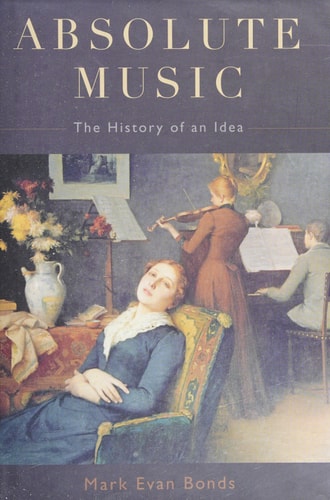
Absolute Music: The History of an Idea
0
0
As an Amazon Associate and affiliate partner, Menrva Books earns from qualifying purchases. Learn more
Author Description
What Is Music, And Why Does It Move Us? From Pythagoras To The Present, Writers Have Struggled To Isolate The Essence Of Pure Or Absolute Music In Ways That Also Account For Its Profound Effect. In Absolute Music: The History Of An Idea, Mark Evan Bonds Traces The History Of These Efforts Across More Than Two Millennia, Paying Special Attention To The Relationship Between Music's Essence And Its Qualities Of Form, Expression, Beauty, Autonomy, As Well As Its Perceived Capacity To Disclose Philosophical Truths. The Core Of This Book Focuses On The Period Between 1850 And 1945. Although The Idea Of Pure Music Is As Old As Antiquity, The Term Absolute Music Is Itself Relatively Recent. It Was Richard Wagner Who Coined The Term, In 1846, And He Used It As A Pejorative In His Efforts To Expose The Limitations Of Purely Instrumental Music. For Wagner, Music That Was Absolute Was Isolated, Detached From The World, Sterile. His Contemporary, The Viennese Critic Eduard Hanslick, Embraced This Quality Of Isolation As A Guarantor Of Purity. Only Pure, Absolute Music, He Argued, Could Realize The Highest Potential Of The Art. Bonds Reveals How And Why Perceptions Of Absolute Music Changed So Radically Between The 1850s And 1920s. When It First Appeared, Absolute Music Was A New Term Applied To Old Music, But By The Early Decades Of The Twentieth Century, It Had Become-paradoxically--an Old Term Associated With The New Music Of Modernists Like Schoenberg And Stravinsky. Bonds Argues That The Key Developments In This Shift Lay Not In Discourse About Music But Rather The Visual Arts. The Growing Prestige Of Abstraction And Form In Painting At The Turn Of The Twentieth Century-line And Color, As Opposed To Object-helped Move The Idea Of Purely Abstract, Absolute Music To The Cutting Edge Of Musical Modernism. By Carefully Tracing The Evolution Of Absolute Music From Ancient Greece Through The Middle Ages To The Twentieth-century, Bonds Not Only Provides The First Comprehensive History Of The Idea But Also Explains Why It Remains So Central To Our Understanding Of Music Today.
Menrva's Summary
THE THESIS
What is the historical origin and philosophical evolution of the concept of 'absolute music' as a detached, pure art form? Mark Evan Bonds, a distinguished musicologist, examines the intellectual history of instrumental music from antiquity to the mid-twentieth century. By analyzing the shifting definitions of musical autonomy, expression, and form, he argues that the concept of absolute music was fundamentally reshaped by the rise of abstraction in the visual arts during the early twentieth century.
THE SCOPE MAP
What You Will Find
- A chronological survey of musical aesthetics from Pythagoras to the mid-twentieth century.
- An analysis of the terminological shift initiated by Richard Wagner and Eduard Hanslick.
- A comparative study linking musical modernism to the development of abstract painting.
- An investigation into the philosophical tension between music as an autonomous entity and music as a vehicle for expression.
THE AUTHORITY PERSPECTIVE
Scholars and music historians recognize this work as a definitive intellectual history of a complex aesthetic concept. Readers frequently note the academic rigor of the prose, which provides a foundational framework for understanding the intersection of musicology and philosophy.
Page Count:
375
Publication Date:
2014-01-01
Publisher:
Oxford University Press, Incorporated
ISBN-10:
0199343640
ISBN-13:
9780199343645
Music
Non-Fiction
Philosophy
Music theory
Music History
Music
Community Tags
Other Editions(2)
Similar Books

![Great ideas in music ([Great ideas series, no. 2])](https://storage.googleapis.com/menrva_img_storage/covers/9780080070728.jpg)
Reader Comments
Share Your Thoughts
No comments yet. Be the first to share your thoughts!