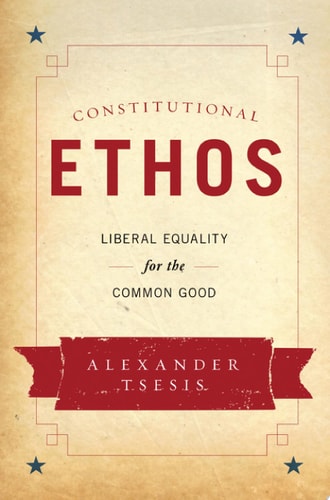
Constitutional Ethos: Liberal Equality for the Common Good
0
0
As an Amazon Associate and affiliate partner, Menrva Books earns from qualifying purchases. Learn more
Author Description
Judges, courts, and scholars in the United States agree that the Constitution is the supreme law of the land, but there is much disagreement about its meaning. So what seems to be incontestable truth is riddled with disagreements about every day questions of decision making on matter such as whether people are entitled to government created programs, what rights are fundamental, the criteria for voting, the three branches of governments' several responsibilities, and even who should have the final say in defining the Constitution's meaning.Constitutional Ethos is a groundbreaking investigation into the fundamental principles of constitutional principle, meaning, and interpretation. It explores the core purposes of American representative democracy in light of historical sources, recent precedents, and contemporary debates. Alexander Tsesis argues that a central norm of U.S. law can be derived from the Declaration of Independence and Preamble. This book develops a theory of constitutional law structured on the public duty to protect individual rights for the general welfare. The maxim of constitutional governance synthesizes the protection of individual and public rights. The ideal is neither solely theoretical nor customary but tied to a firm foundation that the people then build upon by lobbying elected officials and petitioning appointed judges. Representative government has an interlinked obligation to the individual and the general welfare. This paradigm for responsible governance sets the baseline against which citizens can hold policy makers accountable to the structural and normative commitments of the Constitution. A pluralistic system must respect human dignity and govern for the betterment of the body politic.Those mandates set the terms for exercising legitimate power at the federal, state, and local levels to protect individual rights to achieve the common good of civil society. Tsesis demonstrates that ethos is binding on the conduct of all three branch
Menrva's Summary
THE THESIS
How can the United States Constitution be interpreted to reconcile the protection of individual rights with the pursuit of the common good? Alexander Tsesis, a scholar of constitutional law, examines the foundational principles of American democracy by synthesizing historical sources, such as the Declaration of Independence, with contemporary legal precedents. He proposes a theory of constitutional ethos that mandates a dual obligation for government: the protection of individual liberties and the advancement of the general welfare. This framework serves as a normative baseline for evaluating the legitimacy of government actions across all three branches.
THE SCOPE MAP
What You Will Find
- Analysis of the structural and normative commitments embedded in the U.S. Constitution.
- A proposed theory of constitutional ethos linking individual rights to the general welfare.
- Evaluation of historical documents including the Declaration of Independence and the Preamble.
- Examination of the responsibilities of the three branches of government in a pluralistic democracy.
THE AUTHORITY PERSPECTIVE
Legal scholars and political theorists frequently cite this work as a significant contribution to the ongoing discourse regarding constitutional interpretation and the role of the state. Readers often note the academic rigor of the text, which provides a structured framework for understanding the ethical obligations of representative government.
Page Count:
216
Publication Date:
2017-03-27
Publisher:
Oxford University Press
ISBN-10:
0199359849
ISBN-13:
9780199359844
Philosophy
American Government
Professional Career & Trade
Law
Liberalism
United States
Constitutional Law
Community Tags
Similar Books