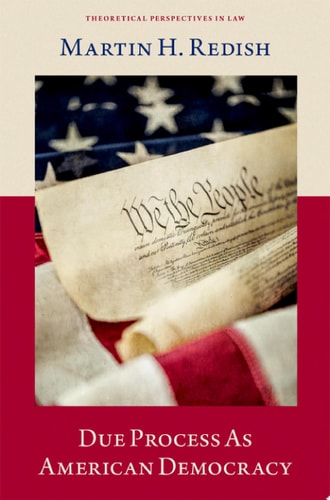
Due Process as American Democracy
0
0
As an Amazon Associate and affiliate partner, Menrva Books earns from qualifying purchases. Learn more
Author Description
Procedural due process guarantees to individual members of the polity that government will treat each of them with fairness and respect when seeking to take their life, liberty, or property. Although enshrined in the US Constitution's Fifth and Fourteenth Amendments, the scope of those guarantees has long been a source of public and academic debate.Due Process as American Democracy develops an entirely new approach to the procedural due process, grounded in foundational precepts of American political theory. It argues that American political thought comes from an adversarial understanding of democracy where individuals need to protect their own interests, because no one else can be trusted to do so. This skeptical democracy informs the separation of powers and operates as the protector of liberal democracy. When applied to procedural due process, adversary democracy dictates a skepticism of both judges and those who seek unilaterally to represent the individuals' interests. The end result is a demand for strong protections of judicial neutrality and independence far beyond what is presently required and imposition of serious restrictions on the ability of courts to appoint others to protect individuals' legally protected interests. The book applies these underlying democratic premises to areas of modern civil procedure and constitutional law, urging dramatic alterations in both.Original and provocative,Due Process as American Democracy provides a fresh view of the constitutional guarantee of due process and will appeal to legal scholars, practitioners, and political theorists alike.
Menrva's Summary
THE THESIS
This book investigates whether the current application of procedural due process aligns with the foundational adversarial principles of American democracy. Martin H. Redish, a scholar of constitutional law, utilizes historical political theory to challenge existing judicial interpretations of the Fifth and Fourteenth Amendments. He argues that the American system is built upon a skeptical view of authority, which necessitates a more robust protection of individual interests through judicial neutrality and independence.
THE SCOPE MAP
What You Will Find
- Analysis of the Fifth and Fourteenth Amendments in the context of political theory
- Examination of the adversarial model of democracy as a safeguard for individual rights
- Critique of modern civil procedure and judicial appointment practices
- Proposals for reform regarding judicial neutrality and the representation of individual interests
THE AUTHORITY PERSPECTIVE
Legal scholars and political theorists recognize this work as a provocative contribution to constitutional discourse. Experts frequently note the density of the author's theoretical framework and its implications for contemporary legal practice.
Page Count:
320
Publication Date:
2024-01-01
Publisher:
Oxford University Press
ISBN-10:
0197747418
ISBN-13:
9780197747414
Constitutional Law
American Government
Law
Civil Procedure
United States
Community Tags
Other Editions(2)
Similar Books