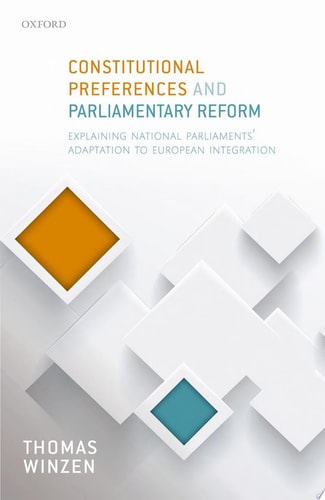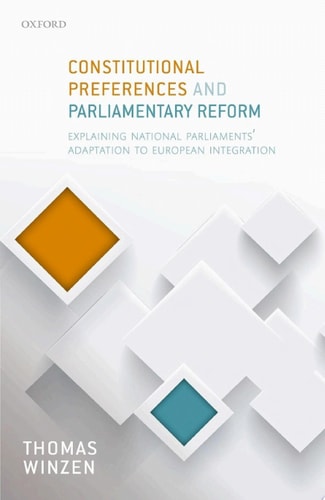
Constitutional Preferences and Parliamentary Reform: Explaining National Parliaments' Adaptation to European Integration
0
0
As an Amazon Associate and affiliate partner, Menrva Books earns from qualifying purchases. Learn more
Author Description
This book provides a comprehensive account of national parliaments' adaptation to European integration. Advancing an explanation based on political parties' constitutional preferences, the volume investigates the nature and variation of parliamentary rights in European Union affairs across countries and levels of governance. In some member states, parliaments have traditionally been strong and parties hold intergovernmental visions of European integration. In these countries, strong parliamentary rights emerge in the context of parties' efforts to realise their preferred constitutional design for the European polity. Parliamentary rights remain weakly developed where federally-oriented parties prevail, and where parliaments have long been marginal arenas in domestic politics. Moreover, divergent constitutional preferences underlie inter-parliamentary disagreement on national parliaments' collective rights at the European level. Constitutional preferences are key to understanding why a 'Senate' of national parliaments never enjoyed support and why the alternatives subsequently put into place have stayed clear of committing national parliaments to any common policies. This volume calls into question existing explanations that focus on strategic partisan incentives arising from minority and coalition government. It, furthermore rejects the exclusive attribution of parliamentary 'deficits' to the structural constraints created by European integration and, instead, restores a sense of accountability for parliamentary rights to political parties and their ideas for the European Union's constitutional design.
Menrva's Summary
THE THESIS
This book investigates why national parliaments across the European Union exhibit significant variation in their formal rights and influence regarding European integration. Thomas Winzen, a political scientist specializing in European governance, argues that these differences are not merely products of structural constraints or partisan government dynamics, but are fundamentally shaped by the constitutional preferences held by national political parties. By analyzing the ideological visions parties maintain for the European polity, the author provides a framework to explain both domestic parliamentary strength and the failure of collective inter-parliamentary institutions.
THE SCOPE MAP
What You Will Find
- A comparative analysis of parliamentary rights across various European Union member states.
- A theoretical framework linking party ideology to constitutional design preferences.
- An examination of the failure of proposals for a 'Senate' of national parliaments.
Scope Limits
- The study does not focus on the day-to-day legislative output of individual members of parliament.
- It does not provide a comprehensive history of every treaty negotiation within the European Union.
THE AUTHORITY PERSPECTIVE
Experts in European studies recognize this work as a significant contribution to the literature on parliamentary adaptation and institutional design. Readers frequently note the academic density of the prose and the rigor with which the author challenges conventional wisdom regarding partisan incentives.
Page Count:
241
Publication Date:
2017-01-01
Publisher:
OUP Oxford
ISBN-10:
0192511920
ISBN-13:
9780192511928
American Government
European Union
Comparative Politics
Parliamentary Studies
Constitutional Law
Community Tags
Similar Books