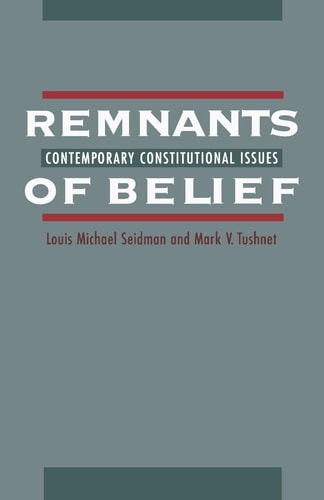
Remnants of Belief: Contemporary Constitutional Issues (10)
0
0
As an Amazon Associate and affiliate partner, Menrva Books earns from qualifying purchases. Learn more
Author Description
Popular debate about constitutional issues such as abortion, affirmative action, the death penalty, and free speech, has become increasingly polarized, with a persistent and growing tendency to treat constitutional questions such as these as if they were easy and the answers obvious. In Remnants of Belief: Contemporary Constitutional Issues, Seidman and Tushnet investigate this phenomenon, tracing its beginning to the transformation of American government that accompanied the New Deal revolution over a half century ago. In their investigation, the authors examine the debates on issues such as free speech, criminal procedure, discrimination, and capital punishment, and the views of prominent figures in the field such as Robert Bork, Laurence Tribe, and Cass Sunstein. The book explores popular constitutional argument and suggests some common reasons why all sides of modern constitutional debate are unsatisfactory. It explores the reasons why constitutional argument has ceased to serve its primary function: to bridge the gaps between citizens by appealing to the principles that unite them.
Menrva's Summary
THE THESIS
This book investigates why contemporary American constitutional discourse has become increasingly polarized and ineffective at bridging societal divides. The authors, both distinguished legal scholars, analyze the historical shift in governance following the New Deal to explain why constitutional questions are now frequently treated as simple matters with obvious answers. By examining the arguments surrounding high-profile legal issues, they argue that modern constitutional debate has lost its capacity to unite citizens through shared principles.
THE SCOPE MAP
What You Will Find
- Historical analysis of the American government transformation post-New Deal
- Critical examination of debates regarding abortion, affirmative action, and the death penalty
- Comparative study of legal theories from prominent figures like Robert Bork, Laurence Tribe, and Cass Sunstein
- Evaluation of the structural failures in current popular constitutional argumentation
THE AUTHORITY PERSPECTIVE
Legal scholars and political scientists frequently cite this work as a critical examination of the decline in deliberative constitutional discourse. Experts highlight the text for its rigorous critique of how both sides of the political spectrum utilize constitutional rhetoric to avoid substantive engagement.
Page Count:
240
Publication Date:
1996-03-07
Publisher:
Oxford University Press
ISBN-10:
019509980X
ISBN-13:
9780195099805
History
United States
American Government
Law
Constitutional Law
Community Tags
Similar Books