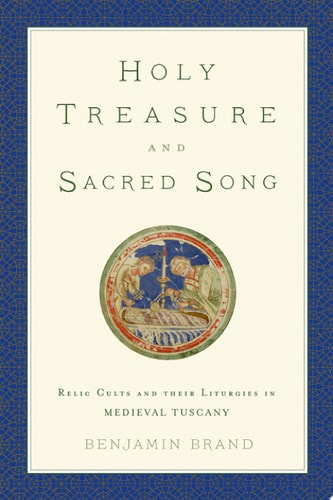
Holy Treasure and Sacred Song: Relic Cults and their Liturgies in Medieval Tuscany
0
0
As an Amazon Associate and affiliate partner, Menrva Books earns from qualifying purchases. Learn more
Author Description
In the Middle Ages, relic cults provoked rich expressions of devotion not only in hagiographic literature and visual art but also in liturgical music and ritual. Despite the long-recognized inter-play between these diverse media, historians of the period rarely integrate analysis of sacred music into their research on other modes of worship espoused by relic cults. Holy Treasure and Sacred Song situates this oft-neglected yet critical domain of religious life at the center of an examination of relic cults in medieval Tuscany. Long recognized as a center of artistic innovation during the Renaissance, this region also boasted the rich and well documented veneration of holy bishops and martyrs buried in the cathedrals and suburban shrines of its principal cities. Author Benjamin Brand reveals that the music composed to honor these local saints - no fewer than ninety chants for the Mass and Divine Office - were essential components of larger devotional campaigns that included the recording of their life stories and the building and decoration of their shrines. Furthermore, the local Tuscan clerics who assumed control of these campaigns with the intent of gaining both temporal and spiritual power drew on influential global models - literary, architectural, musical, and ritual - from preeminent European powers, Rome and the Carolingian Empire. By integrating detailed analyses of plainsong and sacred ritual into this rich panorama, Brand traces the dialectic between local, regional, and pan-European trends, revealing the centrality of the liturgy in the development of medieval relic cults and, in a broader sense, medieval European culture and politics. Offering a rich topography of music, liturgy, and devotion through an interdisciplinary approach ideal for the multifaceted nature of medieval relic cults, Holy Treasure and Sacred Song will find a broad audience amongst musicologists and medievalists alike.
Menrva's Summary
THE THESIS
This book investigates the intersection of liturgical music, ritual practice, and the veneration of relics within the socio-political landscape of medieval Tuscany. Benjamin Brand, a scholar of medieval music and liturgy, utilizes a vast corpus of over ninety chants for the Mass and Divine Office to argue that sacred music was a fundamental component of devotional campaigns. By examining the interplay between local saint cults and broader European power structures, Brand demonstrates how Tuscan clerics leveraged musical and ritual innovation to consolidate both temporal and spiritual authority.
THE SCOPE MAP
What You Will Find
- Analysis of over ninety chants for the Mass and Divine Office dedicated to local saints.
- Examination of the relationship between liturgical music and the construction of shrines and hagiographic texts.
- Historical investigation into the influence of Roman and Carolingian models on Tuscan religious practice.
- Interdisciplinary methodology combining musicology, political history, and religious studies.
THE AUTHORITY PERSPECTIVE
Scholars in the fields of musicology and medieval history recognize this work as a significant contribution to the study of relic cults, particularly for its integration of liturgical evidence into broader historical narratives. The text is noted for its rigorous analysis of primary sources and its ability to bridge the gap between regional religious practices and pan-European cultural trends.
Page Count:
320
Publication Date:
2014-01-01
Publisher:
Oxford University Press
ISBN-10:
0199351368
ISBN-13:
9780199351367
History
Religion
Catholic Church
Church music
Music History
Saints
Music italian
Musicology
Humanities
Art History
Community Tags
Other Editions(2)

Similar Books















Reader Comments
Share Your Thoughts
No comments yet. Be the first to share your thoughts!