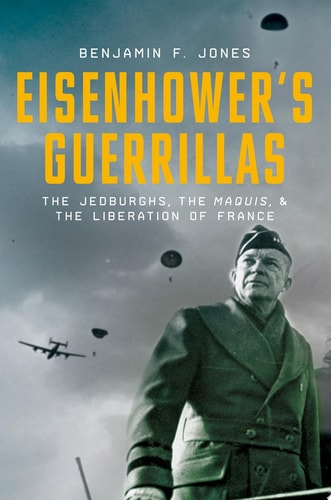
Eisenhower's Guerrillas: The Jedburghs, the Maquis, and the Liberation of France
0
0
As an Amazon Associate and affiliate partner, Menrva Books earns from qualifying purchases. Learn more
Author Description
The challenges facing General Dwight Eisenhower before the Invasion of Normandy were not merely military but political as well. He knew that to liberate France, and to hold it, the Allies needed local help, which would necessitate coordinating with the highly independent French resistance groups known collectively as the maquis. The Allies' objective was to push the Germans out of France. The French objective, on the other hand, was a France free of all foreign armies, including the Allies. President Roosevelt refused to give full support to Charles de Gaulle, whom he mistrusted, and declined to supply the timing, location, and other key details of Operation Overlord to his Free French government. Eisenhower's hands were tied. He needed to involve the French, but without simultaneously involving them in operational planning. Into this atmosphere of tension and confusion jumped teams consisting of three officers each -- one from the British Special Operations Bureau, one from the U.S. Office of Strategic Services, one from the Free French Bureau Central de Renseignement -- as well as a radioman from any one of the three nations. Known as the Jedburghs, their primary purpose was to serve as liaisons to the maquis, working to arm, train, and equip them. They were to incite guerilla warfare. Benjamin Jones' Eisenhower's Guerrillas is the first book to show in detail how the Jedburghs -- whose heroism and exploits have been widely celebrated -- and the maquis worked together. Underscoring the critical and often overlooked role that irregular warfare played in Allied operations on the Continent, it tells the story of the battle for and liberation of France and the complexities that threatened to undermine the operation before it even began.
Menrva's Summary
THE THESIS
This work investigates how the Allied command navigated the complex political and military friction between the Supreme Headquarters Allied Expeditionary Force and the French resistance during the liberation of France. Benjamin F. Jones, a military historian, utilizes archival records and operational reports to examine the deployment of the Jedburgh teams. He argues that the success of the Normandy invasion relied heavily on the integration of irregular warfare, despite the deep-seated mistrust between Allied leadership and Charles de Gaulle's Free French forces. The book provides a framework for understanding how small, multi-national units managed to bridge the gap between strategic Allied objectives and the localized goals of the maquis.
THE SCOPE MAP
What You Will Find
- Detailed operational history of the Jedburgh teams during the liberation of France.
- Analysis of the political tensions between Dwight Eisenhower, Franklin D. Roosevelt, and Charles de Gaulle.
- Examination of the logistical and tactical challenges of arming and training the French resistance.
- Assessment of the impact of irregular warfare on the success of Operation Overlord.
THE AUTHORITY PERSPECTIVE
Experts identify this work as a significant contribution to the study of special operations and Allied coordination during the Second World War. Readers frequently note the meticulous detail regarding the inter-agency cooperation required to sustain guerrilla activities behind enemy lines.
Page Count:
374
Publication Date:
2016-01-01
Publisher:
Oxford University Press
ISBN-10:
019935183X
ISBN-13:
9780199351831
Biography
History
Military History
American History
Guerrillas
Modern History
European History
Community Tags
Other Editions(2)
Similar Books










Reader Comments
Share Your Thoughts
No comments yet. Be the first to share your thoughts!