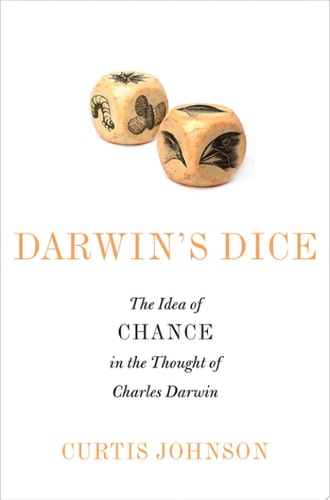
Darwin's Dice: The Idea of Chance in the Thought of Charles Darwin
0
0
As an Amazon Associate and affiliate partner, Menrva Books earns from qualifying purchases. Learn more
Author Description
For evolutionary biologists, the concept of chance has always played a significant role in the formation of evolutionary theory. As far back as Greek antiquity, chance and "luck" were key factors in understanding the natural world. Chance is not just an important concept; it is an entire way of thinking about nature. And as Curtis Johnson shows, it is also one of the key ideas that separates Charles Darwin from other systematic biologists of his time. Studying the concept of chance in Darwin's writing reveals core ideas in his theory of evolution, as well as his reflections on design, purpose, and randomness in nature's progression over the course of history.In Darwin's Dice: The Idea of Chance in the Thought of Charles Darwin, Curtis Johnson examines Darwin's early notebooks, his collected correspondence (now in 19 volumes), and most of his published writing to trace the evolution of his ideas about chance in evolution. This proved to be one of Darwin's most controversial ideas among his reading public, so much so that it drew hostile reactions even from Darwin's scientific friends, not to mention the more general reader. The firestorm of criticism forced Darwin to forge a retreat, not in terms of removing chance from his theory--his commitment to it was unshakable--but in terms of how he chose to present his theory. Briefly, by changing his wording and by introducing metaphors and images (the stone-house metaphor, the evolution of giraffes, and others), Darwin succeeded in making his ideas seem less threatening than before without actually changing his views. Randomness remained a focal point for Darwin throughout his life. Through the lens of randomness, Johnson reveals implications of Darwin's views for religion, free will, and moral theory. Darwin's Dice presents a new way to look at Darwinist thought and the writings of Charles Darwin.
Menrva's Summary
THE THESIS
This book investigates the central role of chance and randomness in Charles Darwin's evolutionary theory and how these concepts shaped his intellectual development. Curtis Johnson, a scholar of Darwinian thought, utilizes a comprehensive analysis of Darwin's early notebooks, extensive correspondence, and published works to argue that chance was a foundational, albeit controversial, pillar of Darwin's worldview. The author demonstrates how Darwin navigated the intense public and scientific backlash against his ideas by strategically adjusting his rhetoric and metaphors while maintaining his core commitment to the role of randomness in natural history.
THE SCOPE MAP
What You Will Find
- Analysis of Darwin's early notebooks and 19 volumes of personal correspondence.
- Examination of the rhetorical shifts and metaphors used to present evolutionary theory to a skeptical public.
- Investigation into the implications of Darwin's randomness for religion, free will, and moral philosophy.
- Historical context regarding the reception of evolutionary theory among Darwin's contemporaries.
THE AUTHORITY PERSPECTIVE
Scholars and historians of science recognize this work as a rigorous examination of the intellectual tensions within Darwin's writing. Readers frequently note the academic density of the prose and the author's meticulous attention to primary source documentation.
Page Count:
288
Publication Date:
2014-01-01
Publisher:
Oxford University Press
ISBN-10:
0199361436
ISBN-13:
9780199361434
Biography
Science
Evolutionary Biology
Evolution
Community Tags
Other Editions(2)

Similar Books



Reader Comments
Share Your Thoughts
No comments yet. Be the first to share your thoughts!