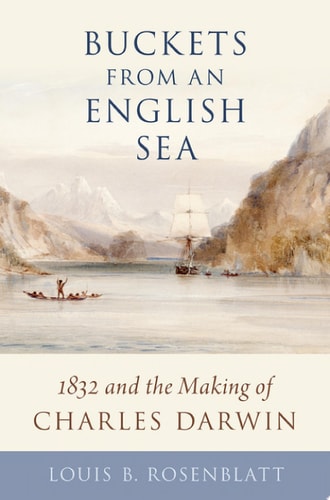
Buckets from an English Sea: 1832 and the Making of Charles Darwin
0
0
As an Amazon Associate and affiliate partner, Menrva Books earns from qualifying purchases. Learn more
Author Description
Darwin did not discover evolution. He didn't trip over it on the way to somewhere else the way Columbus discovered the New World. Like the atom, planetary orbits, and so many other scientific constructs, evolution was invented in order to explain striking phenomena. And it has been most successful. A century and a half has not simply confirmed Darwin's work, it has linked evolution to the mechanisms of life on the molecular scale. It is what life does. Where Darwin had drawn his theories from forest and field, we now set them in the coiling and uncoiling of twists of DNA, linking where they might, with a host of molecular bits and pieces scurrying about.Darwin, himself, however, has been a closed story. A century and a half of study of the man and his work, including close readings of his books, his notebooks and letters, and even the books he read, has led to a working appreciation of his genius. The 'success' of this account has, however, kept us from seeing several important issues: most notably, why did he pursue evolution in the first place? Buckets from an English Sea offers a new view of what inspired Darwin and provoked his work. Stunning events early in the voyage of the Beagle challenged his deeply held conviction that people are innately good. This study of 1832 highlights the resources available to the young Darwin as he worked to secure humanity's innate goodness.
Menrva's Summary
THE THESIS
What specific experiences during the 1832 voyage of the Beagle compelled Charles Darwin to formulate his theory of evolution? Louis B. Rosenblatt examines the intellectual and personal development of the young Darwin, arguing that his scientific pursuits were deeply influenced by a crisis of faith regarding human nature. By analyzing Darwin's early notebooks, correspondence, and the literature he consumed, the author constructs a framework that positions Darwin's scientific output as a response to the challenge of reconciling his observations of human behavior with his belief in innate goodness.
THE SCOPE MAP
What You Will Find
- A detailed analysis of the 1832 timeline of the HMS Beagle voyage.
- Examination of Darwin's personal correspondence and private notebooks.
- A contextual study of the intellectual resources available to Darwin in the early 19th century.
Scope Limits
- The text does not provide a comprehensive biography of Darwin's entire life.
- It does not focus on the technical biological mechanisms of evolution discovered after the 19th century.
THE AUTHORITY PERSPECTIVE
Scholars and readers note that this work provides a focused, psychological look at the motivations behind Darwin's scientific inquiry. The text is recognized for its specific concentration on the 1832 period, offering a niche perspective that complements broader historical accounts of the Beagle expedition.
Page Count:
217
Publication Date:
2017-01-01
Publisher:
Oxford University Press
ISBN-10:
0190654422
ISBN-13:
9780190654429
Biography
History
Non-Fiction
Science History
Earth Sciences
19th Century
Evolution
Evolutionary Biology
Community Tags
Similar Books