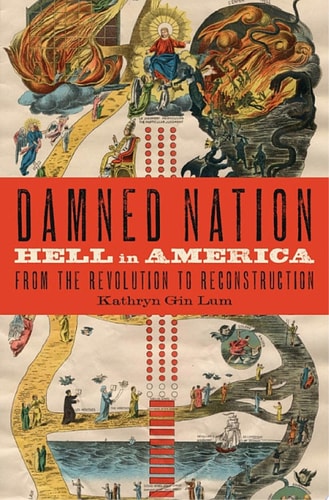
Damned Nation: Hell in America from the Revolution to Reconstruction
0
0
As an Amazon Associate and affiliate partner, Menrva Books earns from qualifying purchases. Learn more
Author Description
Among the pressing concerns of Americans in the first century of nationhood were day-to-day survival, political harmony, exploration of the continent, foreign policy, and--fixed deeply in the collective consciousness--hell and eternal damnation. The fear of fire and brimstone and the worm that never dies exerted a profound and lasting influence on Americans' ideas about themselves, their neighbors, and the rest of the world.Kathryn Gin Lum poses a number of vital questions: Why did the fear of hell survive Enlightenment critiques in America, after largely subsiding in Europe and elsewhere? What were the consequences for early and antebellum Americans of living with the fear of seeing themselves and many people they knew eternally damned? How did they live under the weighty obligation to save as many souls as possible? What about those who rejected this sense of obligation and fear? Gin Lum shows that beneath early Americans' vaunted millennial optimism lurked a pervasive anxiety: that rather than being favored by God, they and their nation might be the object of divine wrath. As time-honored social hierarchies crumbled before revival fire, economic unease, and political chaos, "saved" and "damned" became as crucial distinctions as race, class, and gender. The threat of damnation became an impetus for or deterrent from all kinds of behaviors, from reading novels to owning slaves. Gin Lum tracks the idea of hell from the Revolution to Reconstruction. She considers the ideas of theological leaders like Jonathan Edwards and Charles Finney, as well as those of ordinary women and men. She discusses the views of Native Americans, Americans of European and African descent, residents of Northern insane asylums and Southern plantations, New England's clergy and missionaries overseas, and even proponents of Swedenborgianism and annihilationism. Damned Nation offers a captivating account of an idea that played a transformative role in America's intellectual and cultural history
Menrva's Summary
THE THESIS
How did the pervasive fear of eternal damnation shape the intellectual, social, and political development of the United States from the Revolution through the Reconstruction era? Kathryn Gin Lum, a scholar of American religious history, examines the persistence of hell-fire theology in a nation often characterized by Enlightenment ideals and millennial optimism. By analyzing a wide array of primary sources, she argues that the anxiety of being eternally damned functioned as a critical social hierarchy, influencing behaviors ranging from political discourse to the justification of slavery and the expansion of missionary work.
THE SCOPE MAP
What You Will Find
- Analysis of theological shifts from the era of Jonathan Edwards to the post-Civil War period.
- Examination of how the binary of 'saved' versus 'damned' intersected with race, class, and gender dynamics.
- Use of diverse primary sources including personal diaries, sermons, asylum records, and plantation accounts.
- Investigation into the influence of hell-centric beliefs on American foreign policy and domestic social reform.
THE AUTHORITY PERSPECTIVE
Scholars and historians recognize this work as a significant contribution to the study of American religious culture, noting the depth of the author's archival research. Readers frequently highlight the clarity with which Gin Lum connects abstract theological concepts to the tangible social anxieties of early American life.
Page Count:
328
Publication Date:
2014-01-01
Publisher:
Oxford University Press
ISBN-10:
0199375186
ISBN-13:
9780199375189
Religion
History
American History
Cultural History
Hell
Theology
United States
Community Tags
Similar Books