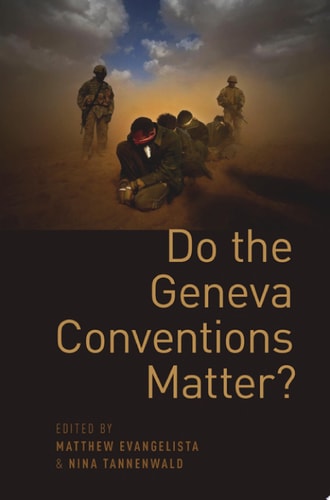
Do the Geneva Conventions Matter?
0
0
As an Amazon Associate and affiliate partner, Menrva Books earns from qualifying purchases. Learn more
Author Description
The Geneva Conventions are the best-known and longest-established laws governing warfare, but what difference do they make to how states engage in armed conflict? Since the start of the "War on Terror" with 9/11, these protocols have increasingly been incorporated into public discussion. We have entered an era where contemporary wars often involve terrorism and guerrilla tactics, but how have the rules that were designed for more conventional forms of interstate violence adjusted?Do the Geneva Conventions Matter? provides a rich, comparative analysis of the laws that govern warfare and a more specific investigation relating to state practice. Matthew Evangelista and Nina Tannenwald convey the extent and conditions that symbolic or "ritual" compliance translates into actual compliance on the battlefield by looking at important studies across history. To name a few, they navigate through the Algerian War for independence from France in the 1950s and 1960s; the US wars in Korea, Vietnam, Iraq, and Afghanistan; Iranian and Israeli approaches to the laws of war; and the legal obligations of private security firms and peacekeeping forces.Thoroughly researched, this work adds to the law and society literature in sociology, the constructivist literature in international relations, and legal scholarship on "internalization." Do the Geneva Conventions Matter? gives insight into how the Geneva regime has constrained guerrilla warfare and terrorism and the factors that affect protect human rights in wartime.
Menrva's Summary
THE THESIS
This work investigates the extent to which the Geneva Conventions effectively constrain state behavior and influence the conduct of modern armed conflict. Authors Matthew Evangelista and Nina Tannenwald, both established scholars in international relations and political science, utilize a constructivist framework to analyze the gap between symbolic adherence to international law and actual battlefield practice. By examining the evolution of warfare from conventional interstate conflict to modern asymmetric threats, the authors argue that the internalization of legal norms is a complex process influenced by political, social, and strategic factors.
THE SCOPE MAP
What You Will Find
- Comparative analysis of state practice regarding the laws of war across multiple historical conflicts.
- Investigation into the role of international norms in regulating guerrilla warfare and terrorism.
- Case studies including the Algerian War, the Vietnam War, and conflicts in Iraq and Afghanistan.
- Examination of the legal obligations pertaining to private security firms and international peacekeeping forces.
THE AUTHORITY PERSPECTIVE
Experts in international law and constructivist theory identify this text as a significant contribution to the study of norm internalization and state compliance. Readers frequently note the academic rigor of the prose and the depth of the historical analysis provided by the authors.
Page Count:
376
Publication Date:
2017-09-13
Publisher:
Oxford University Press
ISBN-10:
0199379785
ISBN-13:
9780199379781
Sociology
Human rights
Warfare
Law
Military Law
International relations