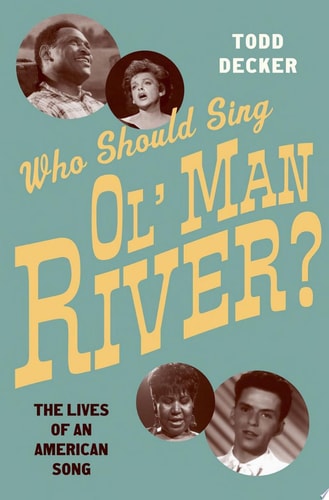
Who Should Sing 'Ol' Man River'?: The Lives of an American Song
0
0
As an Amazon Associate and affiliate partner, Menrva Books earns from qualifying purchases. Learn more
Author Description
A Broadway classic, a call to action, and an incredibly malleable popular song, "Ol' Man River" is not your typical musical theater standard. Written by Jerome Kern and Oscar Hammerstein II in the 1920s for Show Boat, "Ol Man River" perfectly blends two seemingly incongruous traits-the gravity of a Negro spiritual and the crowd-pleasing power of a Broadway anthem. Inspired by the voice of African American singer Paul Robeson, who adopted the tune for his own goals as an activist, "Ol' Man River" is both iconic and transformative. In Who Should Sing "Ol' Man River"? The Lives of an American Song, author Todd Decker examines how the song has shaped, and been shaped by, the African American experience. Yet "Ol' Man River" also transcends both its genre and original conception as a song written for an African American male. Beyond musical theater, this Broadway ballad has been reworked in musical genres from pop to jazz, opera to doo wop, rhythm and blues to gospel to reggae. Pop singers such as Bing Crosby, Frank Sinatra, and Judy Garland made "Ol' Man River" one of their signature songs. Jazz artists such as Bix Biederbecke, Duke Ellington, Dave Brubeck, Count Basie, and Keith Jarrett have all played "Ol' Man River," as have stars of the rock and roll era, such as Sam Cooke, Ray Charles, Aretha Franklin, the Temptations, Cher, and Rod Stewart. Black or white, male or female-anyone who sings "Ol' Man River" must confront and consider its charged racial content and activist history. Performers and fans of musical theater as well as students of the Civil Rights movement will find Who Should Sing "Ol' Man River" an unprecedented examination of a song that's played a groundbreaking role in American history.
Menrva's Summary
THE THESIS
This book investigates the complex cultural, racial, and political history of the song "Ol' Man River" to determine how its meaning has shifted across decades of American performance. Todd R. Decker, a musicologist, utilizes extensive archival research and performance analysis to trace the song's evolution from its origins in the 1920s musical Show Boat to its adoption by diverse artists across multiple genres. He argues that the song functions as a mirror for the American experience, forcing every performer to navigate its inherent racial tensions and activist legacy.
THE SCOPE MAP
What You Will Find
- A detailed historical analysis of the song's composition by Jerome Kern and Oscar Hammerstein II.
- An examination of the influence of Paul Robeson on the song's initial reception and political weight.
- A survey of diverse musical interpretations ranging from jazz and opera to pop and rhythm and blues.
- A critical framework for understanding how racial identity and performance history intersect in American popular music.
THE AUTHORITY PERSPECTIVE
Experts and music historians recognize this work as a definitive study on the intersection of popular music and racial politics in the United States. Readers frequently note the academic rigor of the prose, which provides a thorough examination of how a single composition can reflect broader societal shifts over nearly a century of performance.
Page Count:
253
Publication Date:
2014-01-01
Publisher:
Oxford University Press
ISBN-10:
0199389209
ISBN-13:
9780199389209
History
Music
Music History
Humanities
Musical Theater
Community Tags
Similar Books