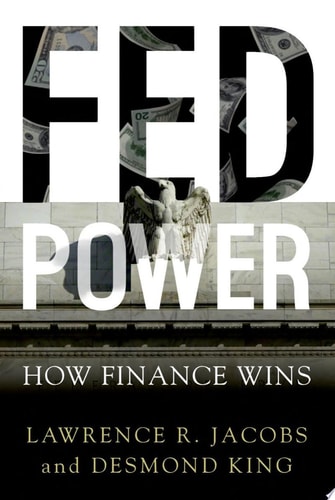
Fed Power
0
0
As an Amazon Associate and affiliate partner, Menrva Books earns from qualifying purchases. Learn more
Author Description
The Federal Reserve, created nearly a century ago, is the most powerful central bank in the world. The Fed's power, which derives from its ability to alter the money supply and move interest rates, weighs heavily not only on the US economy, but on the world economy as well. Not surprisingly, most scholarship on the Fed has focused on its economic role; however, the Fed's power isn't merely economic but is also political. Since its decisions benefit some economic sectors (and hence interest groups) and not others, it effectively makes political choices when shaping economic policy. Lawrence R. Jacobs and Desmond King's Fed Power is the first sustained synthesis of the Fed's political role-especially the way in which it uses its power to benefit some interest groups and not others-since the 2008 financial crisis. The book closely examines the Fed's unilateral actions during the 2008-2009 financial crisis when it leveraged half of the country's net worth without a Congressional vote or Presidential authorization. While the country was spared a second depression, the Fed's actions doled out lopsided benefits to finance. The Fed's favoritism and unprecedented assertions of power provoked public unease and a bipartisan Congressional backlash to restrain it. Fed Power concludes with bold proposals to reform America's financial management to prevent future crises and to restore democratic accountability. A powerful critique of how the Federal Reserve governs the American economy, Fed Power will be essential reading for anyone interested in how inequality has increased since 2009, even throughout a liberal presidency committed to reducing inequality.
Menrva's Summary
THE THESIS
This book investigates the political dimensions of the Federal Reserve, arguing that its economic decisions function as inherently political choices that distribute benefits unevenly across society. Authors Desmond King and Lawrence R. Jacobs, both established scholars in political science and public policy, utilize historical analysis and data from the 2008 financial crisis to challenge the traditional view of the Fed as a purely technocratic institution. They contend that the Fed's unilateral actions during the crisis exacerbated economic inequality and demand a restructuring of financial management to ensure democratic accountability.
THE SCOPE MAP
What You Will Find
- Analysis of the Federal Reserve's political influence and decision-making processes.
- Examination of unilateral actions taken during the 2008-2009 financial crisis.
- Discussion of the relationship between central banking policy and wealth distribution.
- Proposals for institutional reform to increase transparency and democratic oversight.
THE AUTHORITY PERSPECTIVE
Experts recognize this work as a significant contribution to the political economy of central banking, particularly for its focus on the post-2008 regulatory landscape. Readers frequently note the academic rigor of the authors' arguments regarding the intersection of financial power and political inequality.
Page Count:
240
Publication Date:
2016-01-01
Publisher:
Oxford University Press
ISBN-10:
0199388970
ISBN-13:
9780199388974
Economics
History
Public Policy
Finance
Community Tags
Similar Books