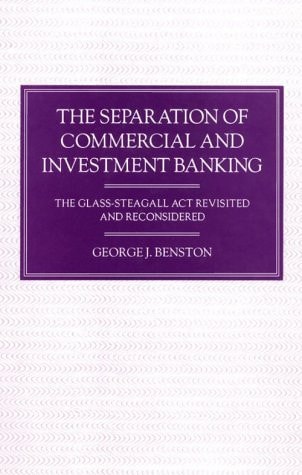
The Separation of Commercial and Investment Banking: The Glass-Steagall Act Revisited and Reconsidered
0
0
As an Amazon Associate and affiliate partner, Menrva Books earns from qualifying purchases. Learn more
Author Description
The 1933 passage of the Glass-Steagall Act by Congress has profoundly effected the way banking has been conducted in the United States. Designed to prevent the kinds of bank failures that resulted from the Crash of 1929 and the Great Depression that followed, the Act made it illegal for commercial banks to engage in investment banking, and for investment banks to engage in commercial banking. This study explores the reasons for the passage of the Act, offers new insights into the forces that shaped the final legislation, and examines the possible consequences of repealing the Act--arguing that repeal will not result in the resumption of the problems that created a need for protective legislation.
Menrva's Summary
THE THESIS
This work investigates whether the separation of commercial and investment banking, mandated by the 1933 Glass-Steagall Act, remains a necessary regulatory framework for modern financial stability. George J. Benston, a noted scholar in finance and accounting, utilizes historical analysis and economic theory to evaluate the origins of the legislation. He challenges the prevailing assumptions regarding the causes of the 1929 market crash and argues that the repeal of the Act would not necessarily precipitate a return to the systemic failures of the Great Depression era.
THE SCOPE MAP
What You Will Find
- Historical analysis of the 1933 legislative environment and the political forces behind the Glass-Steagall Act.
- Economic evaluation of the risks associated with universal banking versus separated banking models.
- Examination of bank failure data from the early 20th century to test the efficacy of the Act.
- Arguments regarding the modernization of financial regulations in a globalized market.
THE AUTHORITY PERSPECTIVE
Experts recognize this text as a significant contribution to the debate surrounding financial deregulation and the historical interpretation of the Great Depression. Readers frequently note the academic density of the prose and the author's rigorous application of economic principles to legislative history.
Page Count:
276
Publication Date:
1990-08-16
Publisher:
Oxford University Press
ISBN-10:
0195208307
ISBN-13:
9780195208306
History
Economics
Public Policy
Finance
Banking
Community Tags
Similar Books