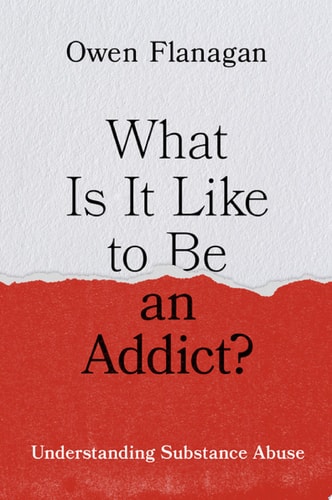
What Is It Like to Be an Addict?: Understanding Substance Abuse
0
0
As an Amazon Associate and affiliate partner, Menrva Books earns from qualifying purchases. Learn more
Author Description
A powerful and important exploration of how addiction functions on social, psychological and biological levels, integrated with the experience of being an addict, from an acclaimed philosopher and former addict.What is addiction? Theories about what kind of thing addiction is are sharply divided between those who see it purely as a brain disorder, and those who conceive of it in psychological and social terms. Owen Flanagan, an acclaimed philosopher of mind and ethics, offers a state-of-the-art assessment of addiction science and proposes a new ecumenical model for understanding and explaining substance addiction.Flanagan has first-hand knowledge of what it is like to be an addict. That experience, along with his wide-ranging knowledge of the philosophy of mind, psychology, neuroscience, and the ethics and politics of addiction, informs this important and novel work. He pairs the sciences that study addiction with a sophisticated view of the consciousness-brain/body relation to make his core argument: that substance addictions comprise a heterogeneous set of "psychobiosocial" behavioral disorders. He explains that substance addictions do not have one set of causes, such as self-medication or social dislocation, and they do not have one neural profile, such as a dysfunction in dopamine system. Some addictions are fun and experimentation gone awry. Flanagan reveals addiction to be a heterogeneous set of disorders, which are picked out by multifarious cultural, social, psychological, and neural features.Flanagan explores the ways addicts sensibly insist on their own responsibility to undo addiction, as well as ways in which shame for addiction can be leveraged into healing. He insists on the collective shame we all bear for our indifference to many of the psychological and social causes of addiction and explores the implications of this new integrated paradigm for practices of harm reduction and treatment. Flanagan's powerful new book upends longstanding conventional t
Menrva's Summary
THE THESIS
What is the fundamental nature of addiction, and how can we reconcile biological, psychological, and social perspectives into a unified model? Owen Flanagan, a philosopher of mind and ethics with personal experience in recovery, argues that addiction is not a monolithic condition but a heterogeneous set of psychobiosocial disorders. By synthesizing neuroscience with philosophical inquiry, he challenges the binary view that addiction is either purely a brain disease or solely a failure of character, proposing instead an integrated framework that accounts for the complexity of human consciousness and social environment.
THE SCOPE MAP
What You Will Find
- An analysis of the psychobiosocial model of addiction that integrates neuroscience, psychology, and ethics.
- A critique of reductionist theories that attribute addiction solely to dopamine dysfunction or social dislocation.
- First-hand accounts and philosophical reflections on the subjective experience of being an addict.
- A discussion on the role of personal responsibility, shame, and collective societal indifference in the treatment of substance abuse.
THE AUTHORITY PERSPECTIVE
Experts and readers alike note that Flanagan provides a sophisticated, interdisciplinary approach that bridges the gap between clinical science and humanistic philosophy. The text is recognized for its academic rigor while remaining accessible to those seeking a deeper understanding of the multifaceted nature of addiction.
Page Count:
312
Publication Date:
2025-01-07
Publisher:
Oxford University Press
ISBN-10:
019938892X
ISBN-13:
9780199388929
Philosophy
Health
Politics
Psychology
Medicine
Addiction Recovery
Addiction
Sociology
Consciousness & Thought
Neuroscience
Community Tags
Other Editions(3)


Similar Books






Reader Comments
Share Your Thoughts
No comments yet. Be the first to share your thoughts!