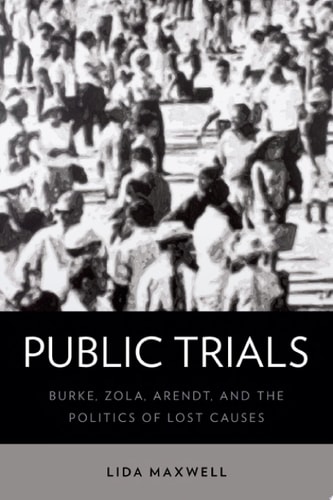
Public Trials: Burke, Zola, Arendt, and the Politics of Lost Causes
0
0
As an Amazon Associate and affiliate partner, Menrva Books earns from qualifying purchases. Learn more
Author Description
There are certain moments, such as the American founding or the Civil Rights Movement, that we revisit again and again as instances of democratic triumph, and there are other moments that haunt us as instances of democratic failure. How should we view moments of democratic failure, when both the law and citizens forsake justice? Do such moments reveal a wholesale failure of democracy or a more contested failing, pointing to what could have been, and still might be?Public Trials reveals the considerable stakes of how we understand democratic failure. Maxwell argues against a tendency in the thinking of Plato, Rousseau and contemporary theorists to view moments of democratic failure as indicative of the failure of democracy, insomuch as such thinking leads to a deference to authority that unintentionally encourages complicity in elite and legal failures to assure justice. In contrast, what Maxwell calls "lost cause narratives" of democratic failure reveal the contingency of democratic failure by showing that things "could have been" otherwise -- and, with public action and response, might yet be. A politics of lost causes calls for democratic responsiveness to failure via practices of resistance, theatrical claims-making, and re-narration.Maxwell makes a powerful case for the politics of lost causes by examining public controversies over trials. She focuses on the dilemmas and diagnoses of democratic failure in four instances: Edmund Burke's speeches and writings on the Warren Hastings trial in late 18th century Britain, Emile Zola's writings on the Dreyfus Affair in late 19th century France, Hannah Arendt's writings on the Eichmann trial in 1960's Israel, and Kathryn Bigelow's recent narration of (the lack of) trials of alleged terrorist detainees in Zero Dark Thirty. Maxwell marshals her subtle, historically grounded readings of these texts to show the dangers of despairing of democracy altogether, as well as the necessity of re-narrating instances of democratic failure.
Menrva's Summary
THE THESIS
How should democratic societies interpret and respond to instances of systemic failure when the law and citizenry abandon the pursuit of justice? Lida Maxwell, a scholar of political theory, investigates the tension between viewing democratic failures as terminal versus viewing them as contingent moments that demand public intervention. By analyzing historical and cultural narratives, she argues that framing these events as 'lost causes' allows for a more active, resistant form of citizenship that rejects passive deference to authority.
THE SCOPE MAP
What You Will Find
- Historical analysis of the Warren Hastings trial, the Dreyfus Affair, and the Eichmann trial.
- Critical examination of contemporary media representations, specifically the film Zero Dark Thirty.
- A theoretical framework for 'lost cause narratives' as a tool for political engagement.
- Methodologies for re-narration and theatrical claims-making as practices of democratic resistance.
THE AUTHORITY PERSPECTIVE
Experts identify this work as a significant contribution to contemporary political theory, particularly for its focus on the intersection of legal history and democratic responsibility. Readers often note the academic density of the prose, which requires familiarity with the works of Burke, Zola, and Arendt to fully appreciate the author's arguments.
Page Count:
256
Publication Date:
2014-01-01
Publisher:
Oxford University Press
ISBN-10:
0199383758
ISBN-13:
9780199383757
History
Philosophy
Justice Administration of
Political Theory
Government
Law
Professional Career & Trade
Community Tags
Other Editions(2)

Similar Books









Reader Comments
Share Your Thoughts
No comments yet. Be the first to share your thoughts!