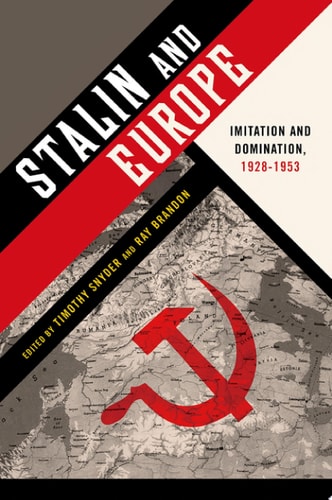
Stalin and Europe: Imitation and Domination, 1928-1953
0
0
As an Amazon Associate and affiliate partner, Menrva Books earns from qualifying purchases. Learn more
Author Description
The Soviet Union was the largest state in the twentieth-century world, but its repressive power and terrible ambition were most clearly on display in Europe. Under the leadership of Joseph Stalin, the Soviet Union transformed itself and then all of the European countries with which it came into contact. This volume considers each aspect of the encounter of Stalin with Europe: the attempt to create a kind of European state by accelerating the European model of industrial development in the USSR; mass murder in anticipation of a war against European powers; the actual contact with Europe's greatest power, Nazi Germany, first as ally and then as enemy; four years of war fought chiefly on Soviet territory and bringing untold millions of deaths, including much of the Holocaust; and finally the reestablishment of the Soviet system, not just in prewar territory of the USSR, but in Western Ukraine, Western Belarus, the Baltic States, Poland, Czechoslovakia, Romania, Hungary, Bulgaria, and East Germany.
Menrva's Summary
THE THESIS
This volume investigates how Joseph Stalin’s leadership transformed the Soviet Union and reshaped the political landscape of Europe through a complex interplay of imitation and domination between 1928 and 1953. Edited by Ray Brandon and Timothy Snyder, the work synthesizes contributions from various historians to analyze the Soviet Union's aggressive modernization, its shifting relationship with Nazi Germany, and the subsequent imposition of the Soviet system across Eastern and Central Europe. The authors argue that Stalin’s policies were not merely reactive but were driven by a specific, often lethal, ambition to replicate and eventually dominate the European model of statehood.
THE SCOPE MAP
What You Will Find
- Analysis of Soviet industrialization strategies modeled after European development patterns.
- Examination of the geopolitical shifts between the Soviet Union and Nazi Germany from 1939 to 1945.
- Documentation of mass violence and the Holocaust within the context of the Eastern Front.
- Detailed accounts of the Sovietization of Poland, Czechoslovakia, Hungary, Romania, Bulgaria, and East Germany.
THE AUTHORITY PERSPECTIVE
Historians and scholars frequently cite this collection as a vital resource for understanding the structural expansion of the Soviet sphere of influence. The text is noted for its rigorous academic approach and its ability to synthesize complex geopolitical history into a coherent narrative of mid-twentieth-century European transformation.
Page Count:
352
Publication Date:
2014-01-01
Publisher:
Oxford University Press
ISBN-10:
0199392595
ISBN-13:
9780199392599
Biography
History
Europe
European History
Military History
Soviet History
Community Tags
Similar Books