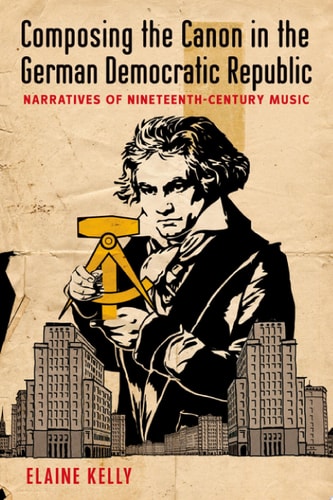
Composing the Canon in the German Democratic Republic: Narratives of Nineteenth-Century Music
0
0
As an Amazon Associate and affiliate partner, Menrva Books earns from qualifying purchases. Learn more
Author Description
When the German Democratic Republic (GDR) was founded in 1949, its leaders did not position it as a new state. Instead, they represented East German socialism as the culmination of all that was positive in Germany's past. The GDR was heralded as the second German Enlightenment, a society in which the rational ideals of progress, Bildung, and revolution that had first come to fruition with Goethe and Beethoven would finally achieve their apotheosis. Central to this founding myth was the Germanic musical heritage. Just as the canon had defined the idea of the German nation in the nineteenth-century, so in the GDR it contributed to the act of imagining the collective socialist state. Composing the Canon in the German Democratic Republic uses the reception of the Germanic musical heritage to chart the changing landscape of musical culture in the German Democratic Republic. Author Elaine Kelly demonstrates the nuances of musical thought in the state, revealing a model of societal ascent and decline that has implications that reach far beyond studies of the GDR itself. The first book-length study in English devoted to music in the GDR, Composing the Canon in the German Democratic Republic is a seminal text for scholars of music in the Cold War and in Germany more widely.
Menrva's Summary
THE THESIS
How did the German Democratic Republic utilize nineteenth-century Germanic musical heritage to construct and legitimize its socialist national identity? Elaine Kelly, a specialist in German music history, examines how GDR leadership framed their state as the successor to the German Enlightenment. By analyzing the reception of composers like Beethoven, the author argues that the musical canon served as a primary instrument for defining socialist progress and cultural continuity within a divided Germany.
THE SCOPE MAP
What You Will Find
- Analysis of the reception history of nineteenth-century German composers within the GDR.
- Examination of the intersection between state-sponsored cultural policy and musical aesthetics.
- Primary source research involving archival documents, music criticism, and state propaganda.
- A framework for understanding how authoritarian regimes manipulate historical narratives to foster national identity.
THE AUTHORITY PERSPECTIVE
Scholars recognize this work as a foundational text for understanding the intersection of musicology and Cold War politics. Experts frequently highlight the academic rigor and the depth of the archival research presented in the study.
Page Count:
264
Publication Date:
2014-01-01
Publisher:
Oxford University Press
ISBN-10:
0199395187
ISBN-13:
9780199395187
History
Humanities
Cold War
Music History
European History
German history
Community Tags
Similar Books