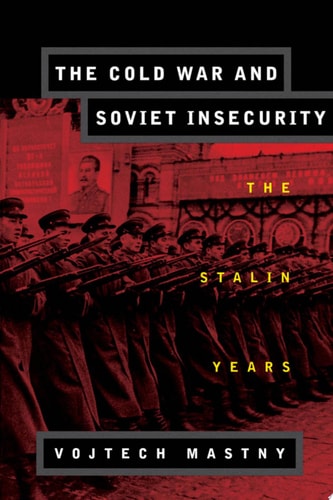
The Cold War and Soviet Insecurity: The Stalin Years
0
0
As an Amazon Associate and affiliate partner, Menrva Books earns from qualifying purchases. Learn more
Author Description
The child of a small coup rather than an extension of popular will, the Soviet State was intrinsically insecure, its leaders ever fearful of internal and external threats. They did not feel that their regime would be safe until the revolution triumphed abroad, convinced that the outside world was implacably hostile. None felt this more strongly than Stalin. Indeed, as eminent historian of the Soviet Union Vojtech Mastny argues, it was Stalin's insatiable craving for security, more than anything else, that was the root cause of East-West tensions and the Cold War. In The Cold War and Soviet Insecurity, the long-awaited sequel to his acclaimed work, Russia's Road to the Cold War, Mastny offers a masterful history of the birth of the Cold War, drawing on extensive research in newly opened Soviet archives. Here Stalin takes center stage during the critical years 1947 to 1953, stamping East-West tensions with his personal blend of paranoia, ideology, ruthlessness, and wishful thinking. Indeed, given Stalin's personality and his unquenchable thirst for security, Mastny argues, the Cold War arose as an "unexpected but predetermined" event--far from planned, yet scarcely avoidable. As Mastny unfolds the history of this climactic era, he offers a new understanding of important aspects of the developing conflict--throwing sharp light, for example, on the Kremlin's relationship with foreign Communist parties (in both Eastern and Western Europe) and its very different responses to Tito and Mao. Indeed, the break with Tito demonstrates the depths of Stalin's paranoia: the Yugoslav leader actually thought he was doing Stalin's will, when all along his very similarity to Stalin alienated the Soviets--a case of "incompatible affinities," as Mastny writes. Here too is a fresh view of the outbreak of the Korean War: Stalin not only approved the attack, he actively armed and prepared the North's Communist army. And yet, he strangely left the most crucial war decisions to the North Kor
Menrva's Summary
THE THESIS
This work investigates whether Joseph Stalin's personal psychological need for security served as the primary catalyst for the origins and escalation of the Cold War. Vojtech Mastny, a recognized historian of Soviet affairs, utilizes newly accessible Soviet archival materials to construct his argument. He posits that the Soviet state's inherent insecurity, exacerbated by Stalin's specific personality traits, transformed East-West tensions from a series of reactive events into a largely predetermined geopolitical conflict.
THE SCOPE MAP
What You Will Find
- Analysis of Soviet foreign policy between 1947 and 1953.
- Examination of the Kremlin's interactions with foreign Communist parties in Europe.
- Comparative study of Stalin's relationships with Tito and Mao.
- Detailed account of Soviet involvement in the origins of the Korean War.
Scope Limits
- The text focuses primarily on the Stalinist era and does not cover the post-1953 developments of the Cold War.
- It does not provide an exhaustive history of Western policy, focusing instead on the Soviet perspective.
THE AUTHORITY PERSPECTIVE
Experts frequently cite this work as a significant contribution to Cold War historiography due to its reliance on previously restricted Soviet archives. Readers often note the academic density of the prose, which is intended for students and scholars of twentieth-century international relations.
Page Count:
277
Publication Date:
1998-01-01
Publisher:
Oxford University Press
ISBN-10:
0190284374
ISBN-13:
9780190284374
History
Biography
American History
Soviet Union
International Security
European History
International relations
Cold War
Community Tags
Similar Books