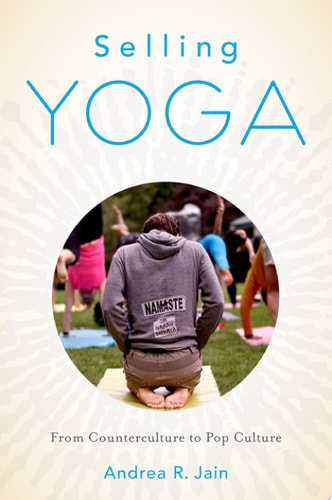
Selling Yoga: From Counterculture to Pop Culture
0
0
As an Amazon Associate and affiliate partner, Menrva Books earns from qualifying purchases. Learn more
Author Description
Premodern and early modern yoga comprise techniques with a wide range of aims, from turning inward in quest of the true self, to turning outward for divine union, to channeling bodily energy in pursuit of sexual pleasure. Early modern yoga also encompassed countercultural beliefs and practices. In contrast, today, modern yoga aims at the enhancement of the mind-body complex but does so according to contemporary dominant metaphysical, health, and fitness paradigms. Consequently, yoga is now a part of popular culture. In Selling Yoga, Andrea R. Jain explores the popularization of yoga in the context of late-twentieth-century consumer culture. She departs from conventional approaches by undermining essentialist definitions of yoga as well as assumptions that yoga underwent a linear trajectory of increasing popularization. While some studies trivialize popularized yoga systems by reducing them to the mere commodification or corruption of what is perceived as an otherwise fixed, authentic system, Jain suggests that this dichotomy oversimplifies the history of yoga as well as its meanings for contemporary practitioners. By discussing a wide array of modern yoga types, from Iyengar Yoga to Bikram Yoga, Jain argues that popularized yoga cannot be dismissed--that it has a variety of religious meanings and functions. Yoga brands destabilize the basic utility of yoga commodities and assign to them new meanings that represent the fulfillment of self-developmental needs often deemed sacred in contemporary consumer culture.
Menrva's Summary
THE THESIS
How did yoga transition from a diverse set of premodern practices into a standardized, commodified fixture of contemporary global consumer culture? Andrea R. Jain, a scholar of religious studies, examines the historical and sociological evolution of yoga by challenging the notion that modern commercialized yoga is merely a corrupted version of an authentic, fixed tradition. She utilizes a framework of consumer culture theory to argue that modern yoga brands serve as vehicles for self-development and religious meaning-making within the current fitness-oriented landscape.
THE SCOPE MAP
What You Will Find
- Historical analysis of premodern and early modern yoga techniques and their diverse original aims.
- Comparative study of various modern yoga systems, including Iyengar Yoga and Bikram Yoga.
- Theoretical framework applying consumer culture studies to religious and spiritual practices.
- Examination of how yoga brands assign new, sacred meanings to commodities in a capitalist society.
THE AUTHORITY PERSPECTIVE
Scholars and critics recognize this work as a significant intervention in the study of modern yoga, specifically for its rejection of essentialist narratives. Readers frequently note the academic density of the prose, which provides a rigorous sociological lens for understanding the intersection of spirituality and the marketplace.
Page Count:
264
Publication Date:
2014-01-01
Publisher:
Oxford University Press
ISBN-10:
0199390266
ISBN-13:
9780199390267
Religion
History
Cultural Anthropology
Sociology
Activities & Sports
Yoga
Community Tags
Other Editions(2)

Similar Books