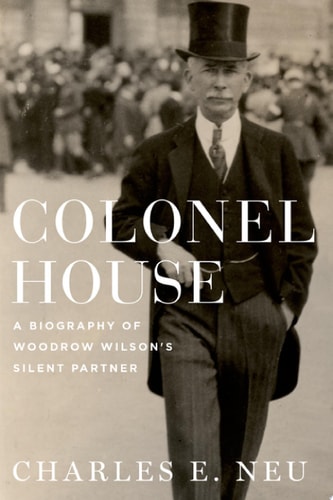
Colonel House: A Biography of Woodrow Wilson's Silent Partner
0
0
As an Amazon Associate and affiliate partner, Menrva Books earns from qualifying purchases. Learn more
Author Description
A man who lived his life mostly in the shadows, Edward M. House is little known or remembered today; yet he was one of the most influential figures of the Wilson presidency. Wilson's chief political advisor, House played a key role in international diplomacy, and had a significant hand in crafting the Fourteen Points at the Paris Peace Conference. Though the intimate friendship between the president and his advisor ultimately unraveled in the wake of these negotiations, House's role in the Wilson administration had a lasting impact on 20th century international politics. In this seminal biography, Charles E. Neu details the life of "Colonel" House, a Texas landowner who rose to become one of the century's greatest political operators. Ambitious and persuasive, House worked largely behind the scenes, developing ties of loyalty and using patronage to rally party workers behind his candidates. In 1911 he met Woodrow Wilson, and almost immediately the two formed what would become one of the most famous friendships in American political history.House became a high-level political intermediary in the Wilson administration, proving particularly adept at managing the intangible realm of human relations. After World War I erupted, House, realizing the complexity of the struggle and the dangers and opportunities it posed for the United States, began traveling to and from Europe as the president's personal representative. Eventually he helped Wilson recognize the need to devise a way to end the war that would place the United States at the center of a new world order. In this balanced account, Neu shows that while House was a resourceful and imaginative diplomat, his analysis of wartime politics was erratic. He relied too heavily on personal contacts, often exaggerating his accomplishments and missing the larger historical forces that shaped the policies of the warring powers. Ultimately, as the Paris Peace Conference unfolded, differences appeared between Wilson and his couns
Menrva's Summary
THE THESIS
This biography investigates the extent to which Edward M. House, a private citizen and political operator, shaped the foreign policy and diplomatic trajectory of the Woodrow Wilson administration. Charles E. Neu, a historian specializing in American diplomacy, utilizes extensive archival research and personal correspondence to reconstruct House's influence. The book argues that while House was instrumental in positioning the United States as a global power during World War I, his reliance on personal diplomacy often obscured his understanding of broader geopolitical forces. Neu provides a critical assessment of the partnership between the president and his advisor, tracing its rise and eventual dissolution.
THE SCOPE MAP
What You Will Find
- Detailed examination of the political landscape of the early 20th century and the rise of the Wilson presidency.
- Analysis of the diplomatic maneuvers surrounding the Paris Peace Conference and the development of the Fourteen Points.
- Primary source evidence derived from House's private papers and correspondence with international leaders.
- A critical evaluation of the strengths and limitations of informal, behind-the-scenes political influence.
THE AUTHORITY PERSPECTIVE
Historians and scholars of the Wilson era recognize this work as a definitive account of a complex political figure who operated outside the traditional bounds of government. Readers frequently note the meticulous research and the balanced, objective tone Neu maintains throughout the narrative.
Page Count:
720
Publication Date:
2014-01-01
Publisher:
Oxford University Press
ISBN-10:
0199391440
ISBN-13:
9780199391448
History
Biography
English & College Success
Statesmen biography
United States
Modern History
Biography Autobiography
American History
English
Diplomacy
Military History
Community Tags
Other Editions(2)

Similar Books















Reader Comments
Share Your Thoughts
No comments yet. Be the first to share your thoughts!