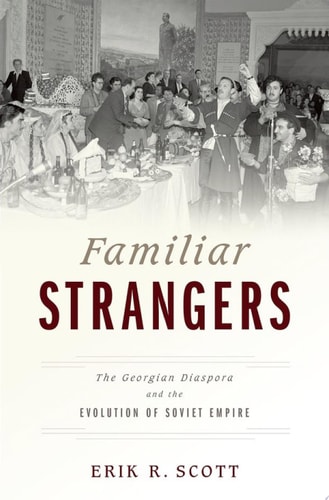
Familiar Strangers: The Georgian Diaspora and the Evolution of Soviet Empire
0
0
As an Amazon Associate and affiliate partner, Menrva Books earns from qualifying purchases. Learn more
Author Description
A small, non-Slavic nation located far from the Soviet capital, Georgia was more closely linked with the Ottoman and Persian empires than with Russia for most of its history. One of over one hundred officially classified Soviet nationalities, Georgians represented less than 2% of the Soviet population, yet they constituted an extraordinarily successful and powerful minority. Familiar Strangers aims to explain how Georgians gained widespread prominence in the Soviet Union, yet remained a distinctive national community. Through the history of a remarkably successful group of ethnic outsiders at the heart of Soviet empire, Erik R. Scott reinterprets the course of modern Russian and Soviet history. Scott contests the portrayal of the Soviet Union as a Russian-led empire composed of separate national republics and instead argues that it was an empire of diasporas, forged through the mixing of a diverse array of nationalities behind external Soviet borders. Internal diasporas from the Soviet republics migrated throughout the socialist empire, leaving their mark on its politics, culture, and economics. Arguably the most prominent diasporic group, Georgians were the revolutionaries who accompanied Stalin in his rise to power and helped build the socialist state; culinary specialists who contributed dishes and rituals that defined Soviet dining habits; cultural entrepreneurs who perfected a flamboyant repertoire that spoke for a multiethnic society on stage and screen; traders who thrived in the Soviet Union's burgeoning informal economy; and intellectuals who ultimately called into question the legitimacy of Soviet power. Looking at the rise and fall of the Soviet Union from a Georgian perspective, Familiar Strangers offers a new way of thinking about the experience of minorities in multiethnic states, with implications far beyond the imperial borders of Russia and Eurasia.
Menrva's Summary
THE THESIS
How did a small, non-Slavic minority from the periphery of the Soviet Union achieve such outsized influence within the imperial center? Erik R. Scott, a scholar of Russian and Eurasian history, utilizes extensive archival research and cultural analysis to challenge the traditional view of the Soviet Union as a monolithic, Russian-led state. He argues that the Soviet Union functioned as an empire of diasporas, where the movement and integration of diverse ethnic groups—specifically Georgians—were fundamental to the construction, maintenance, and eventual critique of the socialist state.
THE SCOPE MAP
What You Will Find
- Historical analysis of Georgian migration patterns throughout the Soviet Union from the early revolutionary period to the collapse of the USSR.
- Examination of the role of Georgian cultural entrepreneurs, culinary specialists, and political figures in shaping Soviet identity.
- Investigation into the informal economic networks and trade practices that allowed Georgian communities to thrive within the socialist system.
- A theoretical framework for understanding the experience of ethnic minorities in multiethnic empires and the dynamics of internal diasporas.
THE AUTHORITY PERSPECTIVE
Historians and political scientists frequently cite this work as a significant contribution to the study of Soviet nationality policy and the internal mechanics of the empire. Scholars highlight the text for its nuanced approach to the Georgian experience, noting that it provides a sophisticated alternative to traditional top-down narratives of Soviet power.
Page Count:
351
Publication Date:
2016-01-01
Publisher:
Oxford University Press
ISBN-10:
0199396396
ISBN-13:
9780199396399
History
European History
Cultural History
Sociology
Soviet History
Special Topics
Community Tags
Similar Books