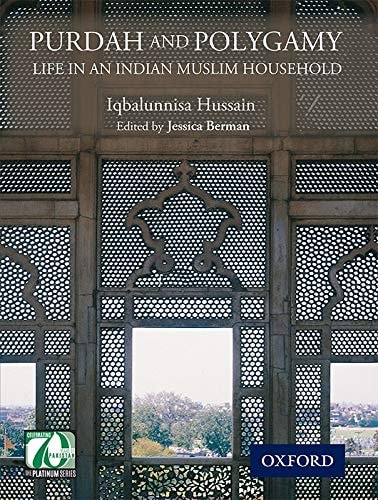
Purdah and Polygamy: Life in an Indian Muslim Household
0
0
As an Amazon Associate and affiliate partner, Menrva Books earns from qualifying purchases. Learn more
Author Description
Originally published in 1944 by Hosali Press, Bangalore, this book is believed to be one of the first full-length English language novel by an Indian Muslim woman in the pre-Partition era. It has clear links with the biting criticism in the feminist Urdu fiction of writers such as Ismat Chughtai and Rashid Jahan. It mounts a scathing attack on the traditional systems of purdah and polygamy in which a man is treated as a virtual god and women, who are often barely literate, as chattel. Through its ironic tone, the novel demonstrates the corrupting influence of this patriarchal system and its power to warp the lives of the women who live under it.For this historically significant work, Jessica Berman of the University of Maryland, Baltimore County, USA, has written the Introduction and provided contextual footnotes for the text. Also included are essays by literary critic Muneeza Shamsie (International Advisory Board, Journal of Postcolonial Writing) and academics, Suvir Kaul (University of Pennsylvania) and Arif Zaman (London School of Business and Management).
Menrva's Summary
THE PULSE
The narrative centers on the restrictive domestic existence of women within an Indian Muslim household, challenging the societal structures of purdah and polygamy. The protagonist navigates a world where patriarchal authority is absolute, often rendering women as subordinate figures within the home. The novel employs an ironic tone to expose the psychological and social consequences of these traditional systems. Through this framework, the author critiques the lack of education and agency afforded to women, highlighting the tension between individual desire and rigid cultural expectations.
INSIDE THE PAGES
- Exploration of the purdah system and its impact on female autonomy
- Critique of polygamy as a tool of patriarchal control
- Use of irony to subvert traditional domestic power dynamics
- Examination of the lack of educational opportunities for women in the pre-Partition era
- Portrayal of the household as a microcosm of broader societal inequality
- Focus on the internal lives of women living under restrictive cultural norms
- Integration of feminist themes consistent with early 20th-century Urdu literary movements
- Historical documentation of gender relations in Indian Muslim society during the 1940s
THE COLLECTIVE ECHO
Readers and critics frequently highlight the historical significance of this work as one of the earliest English-language novels by an Indian Muslim woman. Discussion often centers on the author's biting, ironic prose style, which draws comparisons to the feminist critiques found in the works of Ismat Chughtai. Scholars emphasize the text's role in exposing the corrupting influence of patriarchal systems on both men and women. The inclusion of modern academic introductions and essays provides readers with a robust framework for understanding the cultural context of the pre-Partition era. This novel remains a vital point of interest for those studying the intersection of gender, religion, and colonial-era social reform.
Page Count:
280
Publication Date:
2019-10-01
Publisher:
Oxford University Press
ISBN-10:
0199407568
ISBN-13:
9780199407569
Fiction
India
Social Issues
Feminist
Indian
Historical
Postcolonial
Community Tags
Similar Books