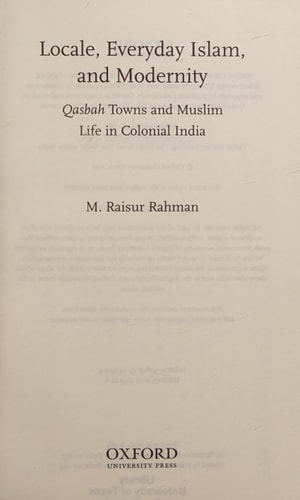
Locale, Everyday Islam, and Modernity: Qasbah Towns and Muslim Life in Colonial India
0
0
As an Amazon Associate and affiliate partner, Menrva Books earns from qualifying purchases. Learn more
Author Description
Scholarship has mostly privileged larger cities as the leading centres in India at the expense of belittling the role and significance of smaller entities. Villages are typically seen on the receiving end of the spectrum and qasbahs (small towns) are often clubbed with them. This book presents qasbahs as centers of intense intellectual and cultural activity in colonial India and as networks of social life, education, print culture, literary production, and intellectual dialogue. Drawing upon a wealth of untapped Urdu, English, Hindi, and Persian sources, it focuses on qasbahs as the new nuclei of Muslim social and cultural life upon the decline of the regional Indian states and their urban centers in the late nineteenth century, just as the successor-states had taken over from the Mughal Empire earlier. It also demonstrates that the emergence of modernity among the Muslims was a process during their colonial encounter in which qasbah residents were active agents and the Islam that emerged was that of everyday living. This volume looks into why locales remain major identity-markers, in addition to affiliations such as nation and religion, and what makes qasbahs still invoke memory and nostalgia among related Muslim individuals and families across the globe.
Menrva's Summary
THE THESIS
This book investigates the historical significance of qasbahs as vibrant, intellectual, and cultural centers of Muslim life in colonial India, challenging the academic tendency to focus exclusively on major metropolitan hubs. M. Raisur Rahman, an expert in South Asian history, utilizes a diverse array of primary sources in Urdu, English, Hindi, and Persian to reconstruct the social landscape of these small towns. He argues that qasbah residents were not passive subjects but active agents in shaping a distinct form of everyday Islam and modernity during the colonial era. By examining the decline of regional states and the subsequent rise of these towns, the author provides a framework for understanding how local identity persists alongside national and religious affiliations.
THE SCOPE MAP
What You Will Find
- Analysis of qasbahs as hubs for print culture, education, and literary production in late nineteenth-century India.
- Examination of the transition from Mughal-era urban centers to colonial-era small town social structures.
- Utilization of multilingual primary source materials including Urdu, English, Hindi, and Persian documents.
- Exploration of the intersection between local identity, memory, nostalgia, and modern Muslim social life.
THE AUTHORITY PERSPECTIVE
Scholars recognize this work as a significant contribution to the study of colonial Indian social history and the decentralization of urban narratives. Readers frequently note the meticulous use of vernacular sources to provide a nuanced view of how modernity was experienced outside of major cities.
Page Count:
296
Publication Date:
2015-10-06
Publisher:
Oxford University Press
ISBN-10:
0199455228
ISBN-13:
9780199455225
History
Sociology
India
Islamic Studies
Cities And Towns
Urban Studies
Colonial History
Community Tags
Similar Books