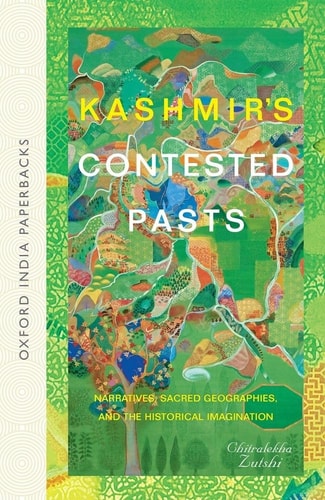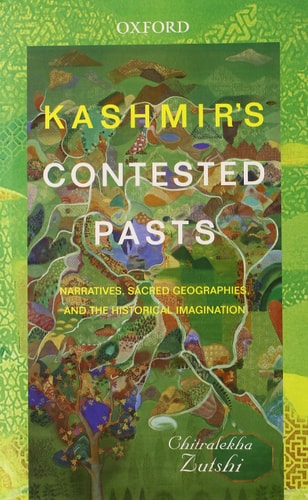
Kashmir's Contested Pasts: Narratives, Sacred Geographies, and the Historical Imagination
0
0
As an Amazon Associate and affiliate partner, Menrva Books earns from qualifying purchases. Learn more
Author Description
This is an extended chronicle of the historical imagination in Kashmir. It explores the conversations between the ideas of Kashmir and the ideas of history taking place within Kashmir's multilingual historical tradition. Contrary to the notion that the Indian subcontinent did not produce histories in the pre-colonial period, the book uncovers the production, circulation, and consumption of a vibrant regional tradition of historical composition in its textual, oral, and performance forms, from the late sixteenth century to the present.History and history-writing, as the book illustrates, were defined in multiple ways-as tradition, facts, memories, stories, common sense, and spiritual practice. Analyzing the deep linkages among Sanskrit, Persian, and Kashmiri narratives, this book contends that these traditions drew on and influenced each other to define Kashmir as a sacred landscape and polity. Within this interconnected narrative tradition, Kashmir was, and continues to be, imagined as far more than simply an unsettled territory or a tourist paradise.Offering a historically grounded reflection on the memories, narrative practices, and institutional contexts that have informed imaginings of Kashmir and its past, this book depicts how Kashmir's history and its territory seem especially embattled in its present political culture. It thus places these contemporary debates over territory, identity, and sovereignty in a much longer historical context.
Menrva's Summary
THE THESIS
This book investigates how the historical imagination in Kashmir has been constructed, contested, and maintained through a diverse, multilingual tradition of narrative and memory. Dr. Chitralekha Zutshi, a scholar of South Asian history, utilizes a wide array of textual, oral, and performance-based sources to challenge the colonial-era assumption that the Indian subcontinent lacked a pre-modern historical tradition. By analyzing the interplay between Sanskrit, Persian, and Kashmiri narratives, the author argues that these traditions collectively shaped Kashmir as a distinct sacred landscape and polity, providing a necessary historical framework for understanding contemporary debates over sovereignty and identity.
THE SCOPE MAP
What You Will Find
- An analysis of historical production from the late sixteenth century to the present day.
- A comparative study of Sanskrit, Persian, and Kashmiri literary and oral traditions.
- Examination of how history is defined through memory, spiritual practice, and political narrative.
- A contextualization of modern territorial and political conflicts within a long-term historical framework.
THE AUTHORITY PERSPECTIVE
Scholars and historians frequently cite this work as a vital intervention in the study of regional historiography and the intellectual history of South Asia. Readers often note the academic density of the prose, which provides a rigorous and nuanced alternative to common political narratives surrounding the region.
Page Count:
378
Publication Date:
2014-07-15
Publisher:
Oxford University Press
ISBN-10:
0199450676
ISBN-13:
9780199450671
History
Politics & Government
Asian History
India historiography