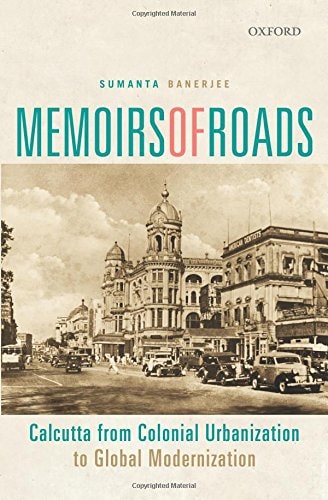
Memoirs of Roads: Calcutta from Colonial Urbanization to Global Modernization
0
0
As an Amazon Associate and affiliate partner, Menrva Books earns from qualifying purchases. Learn more
Author Description
In seventeenth-century India, the fates of three little hamlets were forever changed when East India Company officials chose them to be developed into a city suitable for their settlement. Thus was born Calcutta.In Memoirs of Roads, Banerjee journeys through time and narrates the story of three of the arterial roads of British India's first capital. And through their story, he presents an engrossing history of the development of this remarkable urban landscape, which became a melting pot of Indo-European lifestyle and architecture.He imagines the city as an extended joint family, where the matriarch, Bagbazar Street, watches over the future generations of lanes and by-lanes. Theatre Road is imagined as a midwife, helping to birth the hybrid cultural milieu that characterizes the city. Rashbehari Avenue's rise to prominence is likened to a middle-class Bengali housewife's tentative steps into the limelight of modern society.The author focuses on this family of roads as a site of protests, living spaces, and locations of 'high' and 'low' cultures. Using official archives and popular perceptions, Banerjee scrutinizes the imprints that technology, settlement patterns, transportation, and demography have left on this city.
Menrva's Summary
THE THESIS
This work investigates the evolution of Calcutta from its inception as a colonial outpost to a center of global modernization by examining the historical development of three specific arterial roads. Sumanta Banerjee, a noted scholar of Indian cultural history, utilizes a unique anthropomorphic framework to analyze the city's growth. By treating these roads as members of a family, he synthesizes official colonial archives with local oral traditions and popular perceptions to map the physical and social transformation of the urban landscape.
THE SCOPE MAP
What You Will Find
- Historical analysis of Bagbazar Street, Theatre Road, and Rashbehari Avenue.
- Examination of the intersection between Indo-European architecture and local settlement patterns.
- Integration of official East India Company records and contemporary cultural narratives.
- Analysis of how transportation, technology, and demographic shifts influenced the city's social fabric.
THE AUTHORITY PERSPECTIVE
Scholars and urban historians recognize this text as a significant contribution to the study of colonial Indian urbanism. Readers frequently note the author's creative methodology in blending rigorous archival research with a narrative style that makes complex historical processes accessible.
Page Count:
192
Publication Date:
2016-12-01
Publisher:
Oxford University Press
ISBN-10:
0199468109
ISBN-13:
9780199468102
Architecture
History
India - History
Urban Studies
Sociology
India
Roads -
Cultural History
Community Tags
Similar Books














