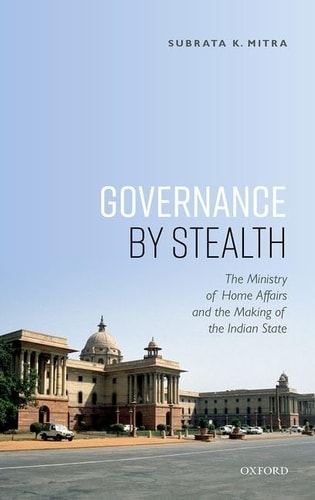
Governance by Stealth: The Ministry of Home Affairs and the Making of the Indian State
0
0
As an Amazon Associate and affiliate partner, Menrva Books earns from qualifying purchases. Learn more
Author Description
India's Ministry of Home Affairs, with its striking durability, and ability to adapt to the transition from colonial rule to post-colonial governance, is a remarkable example of institutional resilience. Home's special expertise in governance by stealth - maximum order with the use of minimum force - was instrumental for the department to acquire a secure niche within the colonial structure. Following the end of colonial rule in 1947, the Home Department, still ensconced in the majestic North Block of Delhi, mutated into the Home Ministry of the Indian Republic. How a colonial institution whose key task was to hold Indian nationalism at bay became the architect of the post-colonial state and nation, is one of the main questions to which I respond in this book. Home's multiple roles as the keeper of public order, mentor to public services and the invisible sinews of the state that holds the noisy democracy and assertive regions together to explain its exalted status in India's governance and politics. My analysis, based on declassified files of the Ministry of Home Affairs, correspondences, biographies and interviews, explores the multiple roles of the Ministry, with its penchant for governance by stealth as my focus
Menrva's Summary
THE THESIS
This book investigates how the Indian Ministry of Home Affairs successfully transitioned from a colonial instrument of control into the foundational architect of the post-colonial Indian state. Subrata K. Mitra, a scholar of Indian politics, utilizes his extensive academic background to analyze the institutional resilience of this department. By examining the shift from colonial rule to democratic governance, Mitra argues that the Ministry maintained its influence through a strategy of 'governance by stealth,' prioritizing order with minimal force to stabilize a complex, diverse nation.
THE SCOPE MAP
What You Will Find
- Historical analysis of the transition from the colonial Home Department to the post-colonial Ministry of Home Affairs.
- Examination of the 'governance by stealth' methodology used to maintain state stability.
- Primary source evidence including declassified government files, personal correspondences, and biographical records.
- Exploration of the Ministry's role in managing public order and regional political tensions within India's democracy.
THE AUTHORITY PERSPECTIVE
Experts recognize this work as a significant contribution to the study of Indian institutional history and state-building. Readers frequently note the academic density of the prose, which provides a rigorous examination of the administrative mechanisms that underpin the Indian state.
Page Count:
472
Publication Date:
2022-02-02
Publisher:
Oxford University Press
ISBN-10:
0199460485
ISBN-13:
9780199460489
Politics
History
Government
Public Administration
Asia history
India
Community Tags
Similar Books