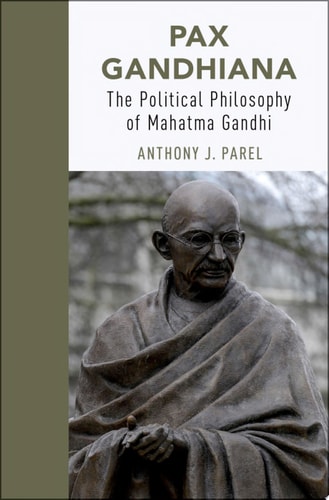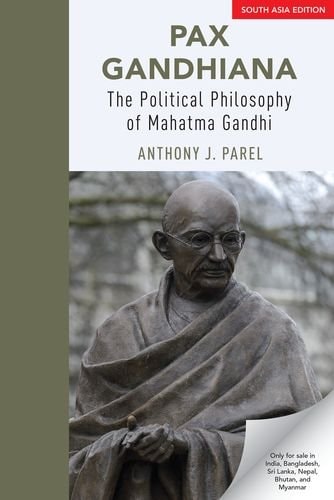
Pax Gandhiana
0
0
As an Amazon Associate and affiliate partner, Menrva Books earns from qualifying purchases. Learn more
Author Description
Notwithstanding his contributions to religion, nonviolence, civil rights, and civil disobedience, among other areas, Gandhi's most significant contribution is that as a political philosopher. While he is not often treated as such, Gandhi was, as Anthony J. Parel argues, a political philosopher sui generis, both in his philosophical method of constant self-criticism and his framework of philosophical analysis. Gandhi wrote daily on politics, but he did so as an activist; political philosophy was to him not just a way of understanding truths of political phenomena but was directly related to understanding those truths in action. If realized in action these truths would give rise to new political institutions, which in turn would create a corresponding peaceful political and social order. Parel dubs this order Pax Gandhiana.The main contention of Pax Gandhiana is that peace cannot be achieved by politics alone. Peace requires the confluence of the canonical ends of politics and economics (artha), ethics (dharma), forms of pleasure (kama), and the pursuit of spiritual transcendence (moksha). Modern political philosophy isolates politics from the other three ends, but Gandhi's originality, according to Parel, lies in the way that he brings all four together. In fact Gandhi's political philosophy is relevant not only to India but also to the rest of the it is a new type of sovereignty that harmonizes the interest of individual states with the community of states.Arguing against scholars who dispute a theoretical unity in Gandhi's writings, Parel suggests that Gandhi is the preeminent non-western political philosopher, and in this book he seeks to identify the conceptual framework of Gandhi's political philosophy, the Pax Gandhiana.
Menrva's Summary
THE THESIS
Does Mahatma Gandhi qualify as a political philosopher whose work offers a viable framework for global peace? Anthony J. Parel, a scholar of Indian political thought, examines Gandhi's extensive writings to argue that his work constitutes a unique, coherent system of political philosophy. By analyzing Gandhi's synthesis of traditional Indian values with modern political action, Parel posits that Gandhi's vision of a peaceful order, or Pax Gandhiana, remains a relevant model for contemporary statecraft and international relations.
THE SCOPE MAP
What You Will Find
- An analysis of the four canonical ends of human life: artha, dharma, kama, and moksha.
- A critique of modern political philosophy's tendency to isolate politics from ethics and spiritual goals.
- A theoretical framework for a new type of sovereignty that balances individual state interests with global community needs.
- A defense of the internal consistency and unity within Gandhi's vast body of political writings.
THE AUTHORITY PERSPECTIVE
Scholars of political theory recognize this work as a significant contribution to the study of non-Western political thought. Readers frequently note the academic density of the prose, which serves as a rigorous examination of Gandhi's intellectual legacy.
Page Count:
0
Publication Date:
1900-01-01
Publisher:
Oxford
ISBN-10:
0199474109
ISBN-13:
9780199474103
History
Biography
Ethics
Political Philosophy
Community Tags
Similar Books