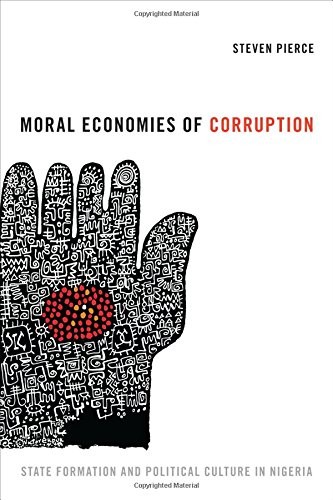
Moral Economies of Corruption
0
0
As an Amazon Associate and affiliate partner, Menrva Books earns from qualifying purchases. Learn more
Author Description
Nigeria is famous for "419" emails asking recipients for bank account information and for scandals involving the disappearance of billions of dollars from government coffers. Corruption permeates even minor official interactions, from traffic control to university admissions. In Moral Economies of Corruption Steven Pierce provides a cultural history of the last 150 years of corruption in Nigeria as a case study for considering how corruption plays an important role in the processes of political change in all states. He suggests that corruption is best understood in Nigeria, as well as in all other nations, as a culturally contingent set of political discourses and historically embedded practices. The best solution to combatting Nigerian government corruption, Pierce contends, is not through attempts to prevent officials from diverting public revenue to self-interested ends, but to ask how public ends can be served by accommodating Nigeria's history of patronage as a fundamental political principle. --Back cover.
Menrva's Summary
THE THESIS
This book investigates the pervasive role of corruption in Nigeria and its implications for political change globally. Steven R. Pierce, drawing on a cultural history of Nigeria over the last 150 years, argues that corruption is not merely a deviation from the norm but a culturally contingent set of political discourses and historically embedded practices. He posits that understanding corruption requires acknowledging its deep roots in patronage as a fundamental political principle, particularly in Nigeria. Pierce suggests that effective solutions must accommodate this history rather than solely attempting to prevent officials from diverting public revenue.
THE SCOPE MAP
- A cultural history of corruption in Nigeria spanning the last 150 years.
- Analysis of corruption as a case study for understanding political change in all states.
- Exploration of corruption as culturally contingent political discourses and historically embedded practices.
- Argument for accommodating Nigeria's history of patronage as a fundamental political principle.
- Examination of the role of corruption in minor official interactions, such as traffic control and university admissions.
- Discussion of large-scale scandals involving the disappearance of government funds.
THE AUTHORITY PERSPECTIVE
The book is presented as a cultural history of corruption in Nigeria, using it as a case study for broader political change. It proposes that corruption is deeply embedded in political practices and discourses, suggesting that solutions should accommodate historical patronage systems. The work aims to reframe the understanding of corruption by highlighting its cultural contingency and historical roots. It offers a perspective that challenges conventional approaches to combating corruption by advocating for accommodation rather than prevention.
Page Count:
282
Publication Date:
2016-01-01
ISBN-10:
0822360918
Economics
Politics
History
Non-Fiction
Sociology
Community Tags
Similar Books