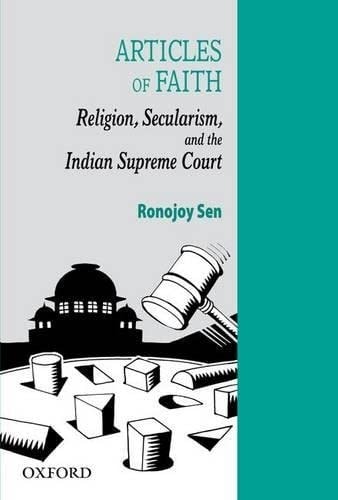
Articles of Faith: Religion, Secularism, and the Indian Supreme Court
0
0
As an Amazon Associate and affiliate partner, Menrva Books earns from qualifying purchases. Learn more
Author Description
This book examines the relationship of religion and the Indian state and seeks to answer the question: 'How has the higher judiciary in Independent India interpreted the right to freedom of religion and in turn influenced the discourse on secularism and nationhood?' The author examines the tension between judgments that attempt to define the essence of religion and in many ways to 'rationalize' it, and a society where religion occupies a prominent space. He places the judicial discourse within the wider political and philosophical context of Indian secularism. The author also focuses on judgments related to Article 44, under the Directive Principles of State Policy, which places a duty on the state to 'secure' a uniform civil code for the nation. His contention is that the Indian Supreme Court has actively aimed at reform and rationalization of obscurantist religious views and institutions and has, as a result, contributed to a 'homogenization of religion' and also the nation, that it has not shown adequate sensitivity to the pluralism of Indian polity and the rights of minorities.The new edition has an expanded and revised introduction, which reviews the new literature on secularism and jurisprudence on religion, both in India and other secular democracies. It also has a new afterword, which examines a few of the recent landmark judgments by the Indian Supreme Court on religion.
Menrva's Summary
THE THESIS
How has the higher judiciary in Independent India interpreted the right to freedom of religion and in turn influenced the discourse on secularism and nationhood? Ronojoy Sen, a scholar of Indian politics and law, investigates the complex interplay between the Indian Supreme Court and the country's religious pluralism. By analyzing judicial interventions in religious affairs, the author argues that the court has frequently sought to rationalize religious practices, inadvertently promoting a homogenization of faith and national identity at the expense of minority rights. The work situates these legal decisions within the broader philosophical framework of Indian secularism and the state's constitutional obligations.
THE SCOPE MAP
What You Will Find
- Analysis of Supreme Court judgments regarding the freedom of religion and the definition of religious essence.
- Examination of Article 44 and the legal discourse surrounding the implementation of a uniform civil code.
- Comparative perspectives on secularism and jurisprudence in India and other secular democracies.
- Discussion of the tension between state-led religious reform and the preservation of cultural pluralism.
THE AUTHORITY PERSPECTIVE
Legal scholars and political scientists identify this work as a critical examination of the Indian judiciary's role in shaping national identity. Readers frequently note the academic density of the prose and the author's meticulous documentation of landmark cases.
Page Count:
304
Publication Date:
2019-03-01
Publisher:
Oxford University Press
ISBN-10:
019948936X
ISBN-13:
9780199489367
Religion
History
Politics
India religion
Supreme Court
Sociology
Law
India