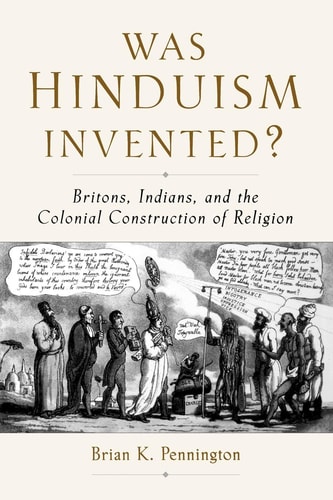
Was Hinduism Invented: Britons, Indians, and the Colonial Construction of Religion
0
0
As an Amazon Associate and affiliate partner, Menrva Books earns from qualifying purchases. Learn more
Author Description
Drawing on a large body of previously untapped literature, including documents from the Church Missionary Society and Bengali newspapers, Brian Pennington offers a fascinating portrait of the process by which "Hinduism" came into being. He argues against the common idea that the modern construction of religion in colonial India was simply a fabrication of Western Orientalists and missionaries. Rather, he says, it involved the active agency and engagement of Indian authors as well, who interacted, argued, and responded to British authors over key religious issues such as image-worship, sati, tolerance, and conversion.
Menrva's Summary
THE THESIS
This book investigates the historical origins of the term and concept of 'Hinduism' to determine if it was a purely colonial fabrication or a collaborative construction. Brian K. Pennington, a scholar of religion, utilizes a diverse array of primary sources, including Church Missionary Society archives and 19th-century Bengali newspapers, to reconstruct the intellectual climate of colonial India. He argues that the definition of Hinduism emerged from a complex, reciprocal dialogue between British observers and Indian intellectuals who actively shaped the discourse on their own religious identity.
THE SCOPE MAP
What You Will Find
- Analysis of 19th-century colonial religious discourse and missionary literature.
- Examination of Bengali newspaper archives and indigenous intellectual responses.
- Case studies on specific religious controversies including image-worship, sati, and conversion.
- A framework for understanding the agency of Indian authors in the colonial construction of religion.
THE AUTHORITY PERSPECTIVE
Scholars frequently cite this work as a nuanced contribution to the study of colonial religious history, noting its departure from simplistic 'Orientalist' critiques. Experts highlight the text for its rigorous use of previously untapped primary sources to demonstrate the active participation of Indian thinkers in defining their own traditions.
Page Count:
260
Publication Date:
2007-10-01
Publisher:
Oxford University Press
ISBN-10:
0195326008
ISBN-13:
9780195326000
History
Religion
Sociology
India
India religion
Colonialism
Community Tags
Similar Books