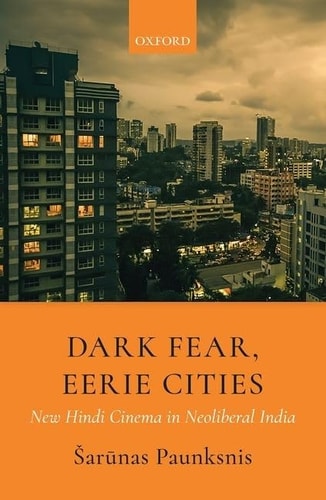
Dark Fear, Eerie Cities: New Hindi Cinema in Neoliberal India
0
0
As an Amazon Associate and affiliate partner, Menrva Books earns from qualifying purchases. Learn more
Author Description
Dark Fear, Eerie Cities analyzes a film form that began to emerge in Hindi cinema in early 21st century - a form that is marked by realism, by focusing on urban life and culture of the new middle class, as well as pessimism, violence, fear and the presence of the 'other' in many forms. The author locates new cinematic developments in a much broader context of sociocultural change in contemporary India, and traces the roots of imagining India 'darkly'. The book looks at the new Hindi cinema from different angles and through analysis of crime thrillers and horror films aims to answer some fundamental questions, Why is there so much of pessimism?; What impact does neoliberalism have on the city and cinematic representations?; Why does the darkness, actual and metaphorical, proliferate?; What haunts the city, and why?; Why is the city so dark and eerie?; And what is the relationship between fear and violence on screen and the actual "dark side" of urban life, crime, insecurity one may feel while living in a metropolis, physical insecurity as well as a psychological, one of competition, a desire to succeed and to belong to 'global India'.
Menrva's Summary
THE THESIS
This book investigates the emergence of a pessimistic, fear-driven aesthetic in 21st-century Hindi cinema as a direct reflection of the sociocultural anxieties inherent in neoliberal India. Author Šarūnas Paunksnis, a scholar specializing in cultural and media studies, utilizes a multidisciplinary framework to connect cinematic shifts with the broader economic and psychological transformations of the Indian middle class. By examining the proliferation of darkness and violence on screen, the text argues that these films serve as a diagnostic tool for understanding the physical and existential insecurities of contemporary urban life.
THE SCOPE MAP
What You Will Find
- Analysis of crime thrillers and horror films within the Hindi cinematic tradition.
- A sociocultural framework linking neoliberal economic policy to urban psychological states.
- Examination of the 'other' as a recurring motif in modern Indian film narratives.
- Investigation into the relationship between screen violence and the lived experience of metropolitan competition.
THE AUTHORITY PERSPECTIVE
Experts in South Asian film studies identify this work as a significant contribution to the understanding of post-liberalization Indian media. Readers frequently note the academic density of the prose, which effectively bridges the gap between film theory and sociopolitical critique.
Page Count:
152
Publication Date:
2019-08-27
Publisher:
Oxford University Press
ISBN-10:
0199493189
ISBN-13:
9780199493180
Politics
Non-Fiction
Sociology
Kindle eBooks
India
Categories
Movies
Cinema
Motion pictures
Kindle Store
Film Studies