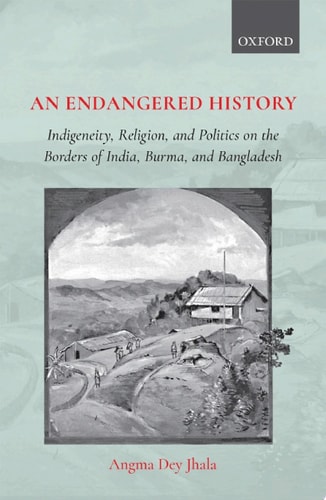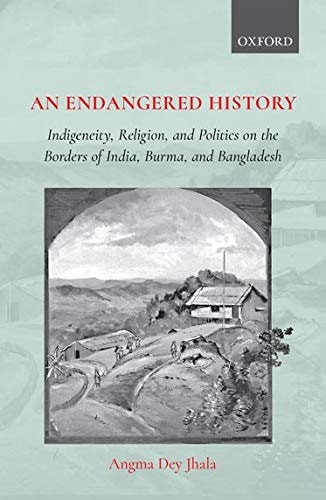
An Endangered History: Indigeneity, Religion, and Politics on the Borders of India, Burma, and Bangladesh
0
0
As an Amazon Associate and affiliate partner, Menrva Books earns from qualifying purchases. Learn more
Author Description
An Endangered History is an account of the little-studied region of the Chittagong Hill Tracts of British-governed Bengal, from the late eighteenth to the mid-twentieth centuries. The Chittagong Hill Tracts lie on the crossroads of India, east Bengal (now Bangladesh) and Burma (contemporary Myanmar). An area of lush rivers and fertile valleys, it has historically been celebrated for its haunting natural beauty and religious heterodoxy from the chronicles of Mughal governors to the ethnohistories of British colonial administrators. The region is composed of several indigenous or 'tribal' communities, whose transcultural histories defied colonial and later postcolonial taxonomies of identity and difference.In particular, this book focuses on how British administrators used European knowledge systems, whether from botany, natural history, gender and sexuality, demography, and anthropology, to construct the autochthone groups of the CHT and their landscapes. In the process, British administrators and later South Asian nationalists would misunderstand and falsely classify the region through the reifying language of religion, linguistics, race and, most perniciously, nation in part due to its unique, and at times perilous, location on the invisible fault lines between South and Southeast Asia. In this manner, this book argues that the colonial archive serves not only to exhume a long forgotten regional past, but also to illuminate a dynamic interconnected global history. It hopes to reestablish the vital place of this much marginalized border region within the larger study of colonial South Asia and Indian nationalism.
Menrva's Summary
THE THESIS
This book investigates how colonial administrative practices and knowledge systems fundamentally misconstrued the identity, religion, and political landscape of the Chittagong Hill Tracts. Dr. Angma Dey Jhala, a scholar of South Asian history, utilizes a vast array of colonial archives, ethnohistories, and administrative records to challenge established narratives. She argues that the region's unique position at the intersection of India, Burma, and Bangladesh was obscured by rigid European taxonomies of race, religion, and nationhood. By re-examining these records, the author demonstrates how the colonial state imposed artificial structures on indigenous communities, ultimately shaping the modern political tensions of the borderlands.
THE SCOPE MAP
What You Will Find
- A detailed historical analysis of the Chittagong Hill Tracts from the late eighteenth to the mid-twentieth centuries.
- An examination of how European knowledge systems—including botany, demography, and anthropology—were applied to indigenous populations.
- A critical study of the intersection between colonial administration and the formation of South Asian nationalist identities.
- An exploration of the region's transcultural history and its role as a fault line between South and Southeast Asia.
THE AUTHORITY PERSPECTIVE
Scholars in the field of South Asian colonial history recognize this work as a significant contribution to the study of marginalized border regions. Experts frequently note the book's rigorous engagement with the colonial archive and its ability to synthesize complex ethnographic data into a coherent critique of imperial classification.
Page Count:
344
Publication Date:
2019-09-01
Publisher:
Oxford University Press
ISBN-10:
0199493081
ISBN-13:
9780199493081
History
Anthropology
Great Britain
Burma history
Colonialism
Asia history
Asia religion