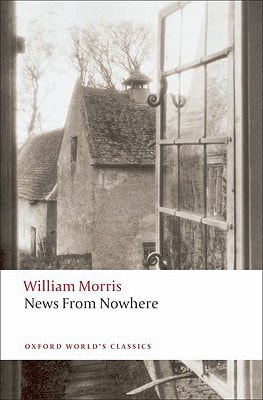
News From Nowhere
0
0
As an Amazon Associate and affiliate partner, Menrva Books earns from qualifying purchases. Learn more
Author Description
News from Nowhere(1890) is the best-known prose work of William Morris and the only significant English utopia to be written since Thomas More's. The novel describes the encounter between a visitor from the nineteenth century, William Guest, and a decentralized and humane socialist future. Set over a century after a revolutionary upheaval in 1952, these "Chapters from a Utopian Romance" recount his journey across London and up the Thames to Kelmscott Manor, Morris's own country house in Oxfordshire. Drawing on the work of John Ruskin and Karl Marx, Morris's book is not only an evocative statement of his egalitarian convictions but also a distinctive contribution to the utopian tradition. Morris's rejection of state socialism and his ambition to transform the relationship between humankind and the natural world, give News from Nowhere a particular resonance for modern readers. This text is based on the 1891 version, incorporating the extensive revisions made by Morris to the first edition.
Menrva's Summary
THE PULSE
A man from the nineteenth century wakes up in a transformed, post-revolutionary future and must navigate a society that has abandoned industrial capitalism for a decentralized, agrarian existence. William Guest serves as the reader's proxy, observing a world where the rigid structures of the Victorian era have been replaced by communal living and a profound connection to the natural environment. The narrative follows his movement through a reimagined London and up the Thames, as he engages in dialogue with the inhabitants of this new world to understand the history of the upheaval that brought it into being. The story unfolds as a series of philosophical encounters, prioritizing ideological exploration over traditional plot-driven conflict.
INSIDE THE PAGES
- First-person narrative perspective through the eyes of William Guest
- Detailed descriptions of a post-industrial, agrarian landscape
- Philosophical dialogues regarding labor, art, and social organization
- Episodic structure following a physical movement across the English countryside
- Integration of socialist and environmentalist political theory
- Contrast between the narrator's Victorian background and the utopian present
- Focus on the aesthetic and humanistic value of craftsmanship
- Exploration of a decentralized, stateless society
THE COLLECTIVE ECHO
Readers and critics frequently highlight the work as a foundational text in the utopian tradition, noting its departure from the state-centric models common in political literature. Discussion often centers on the tension between Morris's romanticized view of pre-industrial life and the practical realities of his socialist vision. Many observers appreciate the atmospheric descriptions of the Thames and the English countryside, which serve as a backdrop for the book's central ideological arguments. While some find the pacing slow due to the emphasis on dialogue over action, others value the text for its clear articulation of egalitarian convictions and its critique of nineteenth-century industrialization.
Page Count:
207
Publication Date:
2009-10-04
Publisher:
Oxford University Press
ISBN-10:
0199539197
ISBN-13:
9780199539192
Science Fiction
Great Britain
Utopian
Political fiction
Utopias
classic
Community Tags
Other Editions(19)

Independently Published
2021
Default edition
Independently Published
2021

Independently Published
2021

Independently Published
2020

Independently Published
2020

Independently Published
2020
Independently Published
2020

Independently Published
2020

Independently Published
2020

Independently Published
2019

Amazon Digital Services LLC - KDP Print US
2019

Blurb, Incorporated
2019

Martino Fine Books
2018
IDB Productions
2016

CreateSpace Independent Publishing Platform
2015
Oxford University Press
2009
Aegypan
2008

Wildside Press
2007
International Publishers
2000
Similar Books



Reader Comments
Share Your Thoughts
No comments yet. Be the first to share your thoughts!