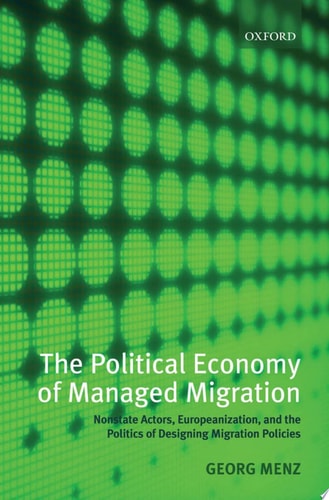
The Political Economy of Managed Migration: Nonstate Actors, Europeanization, and the Politics of Designing Migration Policies
0
0
As an Amazon Associate and affiliate partner, Menrva Books earns from qualifying purchases. Learn more
Author Description
European governments have re-discovered labor migration, but are eager to be perceived as controlling unsolicited forms of migration, especially through asylum and family reunion. The emerging paradigm of managed migration combines the construction of more permissive channels for desirable and actively recruited labor migrants with ever more restrictive approaches towards asylum seekers. Non-state actors, especially employer organizations, trade unions, and humanitarian non-governmental organizations, attempt to shape regulatory measures, but their success varies depending on organizational characteristics. Labor market interest associations' lobbying strategies regarding quantities and skill profile of labor migrants will be influenced by the respective system of political economy they are embedded in. Trade unions are generally supportive of well-managed labor recruitment strategies. But migration policy-making also proceeds at the European Union (EU) level. While national actors seek to upload their national model as a blueprint for future EU policy to avoid costly adaptation, top-down Europeanization is re-casting national regulation in important ways, notwithstanding highly divergent national regulatory philosophies.Based on field work in and analysis of primary documents from six European countries (France, Italy, United Kingdom, Ireland, Germany, and Poland), The Political Economy of Managed Migration makes an important contribution to the study of a rapidly Europeanized policy domain. Combining insights from the literature on comparative political economy, Europeanization, and migration studies, the book makes important contributions to all three, while demonstrating how migration policy can be fruitfully studied by employing tools from mainstream political science, rather than treating it as a distinct subfield.
Menrva's Summary
THE THESIS
This book investigates how non-state actors and national political economies influence the design and implementation of managed migration policies within the European Union. Georg Menz, a scholar of political economy, utilizes a comparative framework to examine the interplay between national regulatory philosophies and the top-down pressures of Europeanization. By analyzing the lobbying efforts of employer organizations, trade unions, and NGOs, the author argues that migration policy is not an isolated domain but a central component of broader political and economic systems.
THE SCOPE MAP
What You Will Find
- Comparative analysis of migration policy across six European nations: France, Italy, United Kingdom, Ireland, Germany, and Poland.
- Examination of the influence exerted by non-state actors, including trade unions and employer associations, on regulatory outcomes.
- Assessment of the tension between national policy models and the top-down process of Europeanization.
- Integration of political economy theory with migration studies to explain policy variations.
THE AUTHORITY PERSPECTIVE
Experts recognize this work as a significant contribution to the study of Europeanized policy domains, particularly for its application of mainstream political science tools to migration. Readers frequently note the academic density of the prose and the rigorous use of primary source documentation across the six studied countries.
Page Count:
264
Publication Date:
2009-02-28
Publisher:
Oxford University Press
ISBN-10:
0199533881
ISBN-13:
9780199533886
Economics
Public Policy
Migration Studies
Asylum Right Of
Community Tags
Similar Books