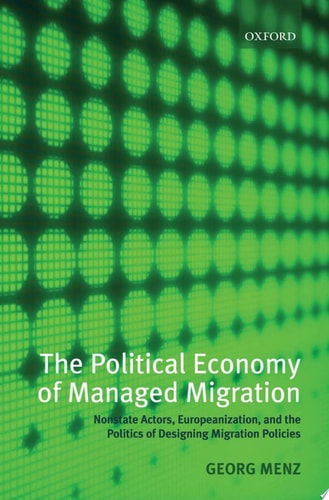
Political Economy of Managed Migration: Nonstate Actors, Europeanization, and the Politics of Designing Migration Policies
0
0
As an Amazon Associate and affiliate partner, Menrva Books earns from qualifying purchases. Learn more
Author Description
European Governments Have Re-discovered Labour Migration, But Are Eager To Be Perceived As Controlling Unsolicited Forms Of Migration, Especially Through Asylum And Family Reunion. The Emerging Paradigm Of Managed Migration Combines The Construction Of More Permissive Channels For Desirable And Actively Recruited Labour Migrants With Ever More Restrictive Approaches Towards Asylum Seekers. Non-state Actors, Especially Employer Organizations, Trade Unions, And Humanitarian Non-governmental Organisations, Attempt To Shape Regulatory Measures, But Their Success Varies Depending On Organizational Characteristics. Labour Market Interest Associations' Lobbying Strategies Regarding Quantities And Skill Profile Of Labour Migrants Will Be Influenced By The Respective System Of Political Economy They Are Embedded In. Trade Unions Are Generally Supportive Of Well-managed Labour Recruitment Strategies. But Migration Policy-making Also Proceeds At The European Union (eu) Level. While National Actors Seek To Upload Their National Model As A Blueprint For Future Eu Policy To Avoid Costly Adaptation, Top-down Europeanization Is Re-casting National Regulation In Important Ways, Notwithstanding Highly Divergent National Regulatory Philosophies. Based On Field Work In And Analysis Of Primary Documents From Six European Countries (france, Italy, United Kingdom, Ireland, Germany, And Poland) This Book Makes An Important Contribution To The Study Of A Rapidly Europeanized Policy Domain. Combining Insights From The Literature On Comparative Political Economy, Europeanization, And Migration Studies, The Book Makes Important Contributions To All Three, While Demonstrating How Migration Policy Can Be Fruitfully Studied By Employing Tools From Mainstream Political Science, Rather Than Treating It As A Distinct Subfield.
Menrva's Summary
THE THESIS
This book investigates how the interplay between national political economies and non-state actors shapes the design and implementation of managed migration policies within the European Union. Georg Menz, a scholar in political economy and European integration, utilizes a comparative framework to analyze how employer organizations, trade unions, and NGOs influence regulatory outcomes. By examining the tension between national regulatory philosophies and top-down Europeanization, the author argues that migration policy is best understood through the lens of mainstream political science rather than as an isolated subfield.
THE SCOPE MAP
What You Will Find
- Comparative analysis of migration policy in France, Italy, the United Kingdom, Ireland, Germany, and Poland
- Examination of lobbying strategies employed by labor market interest associations
- Analysis of the Europeanization process and its impact on national regulatory frameworks
- Theoretical integration of comparative political economy and migration studies
Scope Limits
- The study focuses primarily on the influence of organized interest groups rather than individual migrant experiences
- The analysis is constrained to the specific European countries listed and does not provide a global perspective on migration policy
THE AUTHORITY PERSPECTIVE
Experts recognize this work as a significant contribution to the study of Europeanized policy domains, particularly for its successful application of political economy tools to migration research. Readers frequently note the academic density of the prose and the rigorous use of primary source documentation across the six featured nations.
Page Count:
320
Publication Date:
2009-01-01
Publisher:
Oxford University Press, Incorporated
ISBN-10:
0191559962
ISBN-13:
9780191559969
Economics
Migration Studies
Public Policy
Sociology
Asylum Right Of
European Union
Community Tags
Similar Books