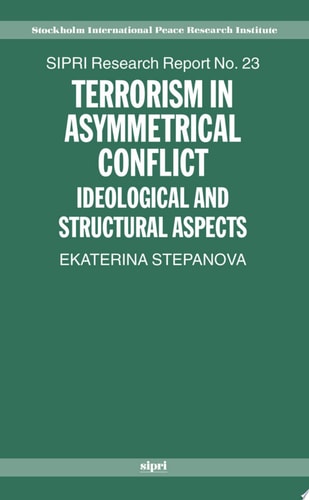
Terrorism in Asymmetric Conflict: Ideological and Structural Aspects
0
0
As an Amazon Associate and affiliate partner, Menrva Books earns from qualifying purchases. Learn more
Author Description
The book's main focus is on extremist ideologies and structural capabilities of violent non-state actors that employ terrorist means. Ideologies and organizational patterns are seen as the main comparative advantages of such groups in an asymmetrical confrontation at all levels, from the local to the global. Resolution of the key issues of the armed conflict is seen as essential, but this is not sufficient to undermine the foundations of terrorism generated by that conflict, unless the structural capabilities of militant groups are fully disrupted and the role of extremist ideologies in driving their terrorist activities is neutralized.With its central focus on Islamist terrorism, the book argues that the quasi-religious, supra-national ideology of violent Islamism, especially in its most ambitious transnational forms, cannot be effectively counterbalanced at the ideological level either by Western democratic secularism or by the use of moderate versions of Islam itself. The author concludes that unless transnational violent Islamism is, first, 'nationalized' and, second, transformed in organizational terms through its being coopted into a more regular political process, it is unlikely to become amenable to persuasion or any external influence, let alone to be destroyed by the repression on which it thrives.The study also proposes an original typology of terrorism based on the overall level of a militant group's goals and the extent to which its terrorist activities are linked to a broader armed conflict. It combines qualitative research with the analysis of available data on trends in modern terrorism and the use of primary sources and writings.
Menrva's Summary
THE THESIS
How do the ideological frameworks and organizational structures of violent non-state actors dictate their effectiveness in asymmetric conflicts? Ekaterina A. Stepanova, a researcher associated with SIPRI, examines the nexus between extremist belief systems and the operational capabilities of militant groups. The author argues that resolving the underlying causes of armed conflict remains insufficient for neutralizing terrorism unless the structural foundations and ideological drivers of these groups are systematically dismantled or co-opted into formal political processes.
THE SCOPE MAP
What You Will Find
- A comprehensive analysis of Islamist terrorism and its transnational ideological reach.
- An original typology of terrorism categorized by goal orientation and conflict integration.
- Qualitative research synthesized with empirical data on global terrorism trends.
- Primary source analysis of extremist literature and organizational manifestos.
THE AUTHORITY PERSPECTIVE
Experts recognize this report as a rigorous academic examination of the structural mechanics behind modern asymmetric warfare. Scholars frequently cite the text for its detailed typology and its critical assessment of the limitations inherent in current counter-terrorism strategies.
Page Count:
200
Publication Date:
2008-05-25
Publisher:
Oxford University Press
ISBN-10:
0199533555
ISBN-13:
9780199533558
Sociology
Jihad
Terrorism
Conflict Studies
International relations
Community Tags
Similar Books